Showing posts with label goose. Show all posts

Friday, July 24, 2009

Roly Poly, Daddy's Little Fatty

I never bought into the whole low fat diet thing. My parents didn't buy into it and it just never made any sense. Why would you want to eat margarine, which comes from a factory, rather than butter, which comes from a cow? Why eat sugar and preservative laden low-fat cookies when you could just eat real cookies in moderation? When I read Sally Fallon's Nourishing Traditions I finally had some words and some ideas to back up my vague feelings that a low fat diet was inappropriate. Fat isn't evil... in fact, fat is necessary for health and hapiness!

Traditional cultures have always prized fat because it is calorie dense and nutrient dense. From early American and European pig lard to SE Asian coconut oil to Inuit seal blubber fat has been the most sought after and important food stuff around the world. There's a Nature episode where Julia Roberts visits the nomadic people of Mongolia and learns about their culture. My favorite part of the show is how in one frame she is commenting on how gross the traditional butter tea is and in the next wondering how they survive such bitter cold temperatures. It didn't occur to her than the one is directly related to the other.

But in modern America something went wrong and has drastically changed how we view fat. In the middle of the 20th century a number of researchers promoted substituting unsaturated vegetable oils for traditional saturated animal fats and lowering dietary fat intake in general in order to reduce coronary heart disease. One of the best known of these researchers was Ancel Keys who published what became known as the Seven Countries Study which corrolated the lower fat diets of Post World War II Europe and Japan with that of affluent post war United States. Keys' statistical strong association weakens when other countries are added to the Seven, and almost fall apart completely when one takes into account that the Italians and French he studied had a long tradition of animal fats that had simply been put on hold by the devastation of decades of war.

In his New York Times piece What If it's All Been a Big Fat Lie Gary Taubes goes over the science and pseudoscience behind low fat and low carbohydrate diets (his research point to pro low carb and anti low fat diets). He lays out a very convincing story that a combination of imperfect human researchers and impossibly complicated human bodies have led us down a path towards obesity and disease. There is also more and more evidence that our modern diet is excessively high in polyunsaturated fats which are not a part of traditional diets. Polyunsaturated fat in the form of vegetable oil is cheap to produce and with the advances in chemically separating the oil from plant seeds, removing toxic chemicals and deodorizing the oils it has become a staple in every American home, restaurant and food processing plant.

Low fat, high fat? Unsaturated, mono-, poly-, just plain saturated fat? Omegas and LDLs and all that... what's a girl to do? Look to the past, that's what I always say. What would people use for cooking fat if they didn't have mono-cropped soy beans and giant food processing factories?

Using this criteria I have put together a fat primer for you. I present it to you with the reminder that we all do the best we can with what we have. I eat out sometimes, I eat at people's houses sometimes and sometimes I even get a pack of chips out of a vending machine. I am not a whole food Nazi, but when I can I prefer to use the most healthful, traditional cooking fats. Here's what I do in my kitchen... on my best days.

******

Fats for Cooking by Type of Fat

Unrefined coconut oil: This is the work horse of my cooking fats. It is almost flavorless and can be used at pretty high temperatures so I use it anywhere you would use "vegetable oil". It is solid when the weather is cool and liquid when room temps are above about 70F but since it comes in a wide mouth jar I just use a spoon to get it out. It's a little spendy to use for deep frying, but it would be good any other time you are cooking with fat. I usually buy Omega Nutrition brand but that's just because it's available at a good price at my local health food store.

Virgin coconut oil: I treat this as a special fat with amazing antimicrobial properties in addition to lots of medium chain fatty acids and a fantastic smell. It is pretty expensive and cooking might destroy the beneficial properties so I cook with it when I am doing something where coconut would be appreciated, like Thai curry. I melt it for use in baked goods occasionally when the flavor would be appreciated and use it along with butter on my popcorn. And sometimes I make coconut bark. Yuummm. I also use it for a number of body care products like skin cream (coconut oil and jojoba oil with a little scent) and deodorant (coconut oil and baking soda with scent). I buy pint jars at my health food store, but lots of people like Wilderness Family Naturals for 5 gallon buckets.

Butter: Mmm... butter. In addition to slathering this on bread and pouring it over popcorn I do cook with this occasionally. I use it, often mixed with coconut oil, when pan sauteing veggies or frying eggs. Butter does have some amount of water and protein in it so it will burn, but I don't have major problems with that. Ghee or clarified butter is an all purpose cooking fat in French and Indian cooking and can easily be bought or made at home. Raw, pasture raised butter is best but even regular store butter is better than margarine or vegetable oil. Look for imported butter like Kerrygold from Ireland or Anchor from New Zealand. Organic Pastures has a "pastured" butter and most stores sell organic butter these days.

Rendered animal fat: I am still working my way through the 3 pints of goose grease I rendered when I cooked a goose last winter. It's pure white, about butter consistency and has a slight poultry flavor. I enjoy cooking with this anywhere it's flavor would be appreciated or tolerated. I've also used chicken fat and would gladly use lard or tallow if I had it available. Each of these will have different flavors and smoke points but all would be good for general cooking (sauteing veggies, frying onions, browning meat, etc). A note on rendered animal fats.. these are not fats you can buy at any old grocery store.
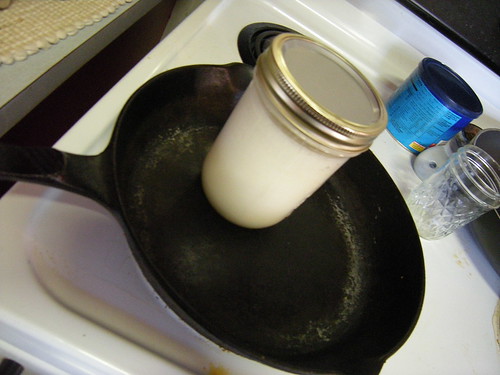
Do NOT buy lard from a regular grocery store. The stuff they sell there is usually adulterated with hydrogenated lard and preservatives. It is not much better for you than crisco. These are fats you need to produce at home or buy from a specialty dealer/farmer. Of course, these fats are best from pastured, organic,happy animals but even grocery store chickens will make fat that is better than hydrogenated lard. You can save scraps from the meat you eat, skim fat from stock making or see if you can buy un-rendered fat from a butcher or farmer. Google around for instructions on rendering it yourself. It's not hard and the rendered fat will keep in jars in the fridge or freezer for a very long time.

Bacon grease: I collect bacon grease and keep it in a mason jar next to the stove. I use it for cooking anything a bacony flavor would be appreciate - which is lots of things. It's the best for starting soups or frying eggs. Mmm...bacon grease. And someday I'll get it together and make that bacon grease mayo recipe that's been floating around....

Olive Oil: Olive oil one of the few traditional liquid oils and is the classic oil for mayonnaise and flavored dipping oils. Buy the best quality you can afford because olive oil is subject to going rancid if not stored properly, and is probably much more adulterated than we would like to think about. It really shouldn't be cooked with. I do, sometimes for flavor, but rarely. Olive oil is much better for you when used in salad dressings or other raw applications because the monounsaturated fats are much more delicate than saturated fats. Extra virgin is the most flavorful, but feel free to use not-extra-virgin as long as you are using oil from a reputable producer.

High oleic sunflower oil: I just found this in the store, finally! It is a high monounsaturated fat oil that should be as healthful as olive oil, but with a different (less olivey perhaps?) flavor. I haven't opened the bottle yet so I can't tell you what it's like but I would use this anywhere I would use olive oil. It would be especially nice for mayo or other salad dressings where you don't necessarily want the olive oil flavor.

Spectrum palm shortening
: I bought this years ago and found it tasted horrible.It is made of deodorized palm oil and is low in polyunsaturated fats, so should be an acceptable fat. Probably a compromise fat because of how processed it is, but low in bad fats anyway. They say it can be used anywhere regular shortening would be used but the pie crust I made with it tasted like soap. Anytime I've used it for cooking I've also gotten a gross soapy flavor. I used it to season my cast iron pans last winter, and sometimes throw a glob in a wiped out cast iron skillet to grease it up and protect it. I might try it on a BBQ sometime. too.

Sunflower, safflower, sesame oil: I have bought these oils in small bottles to make salad dressings with. They are all higher in polyunsaturated fats than we would like to be consuming (especially since I probably still get a fair amount of poly unsaturated fats from factory farmed meat, eating out, eating at friend's houses and occasional packaged foods), but sometimes you have four heads of lettuce in the fridge and really don't want an all olive oil salad dressing. Now that I found the high oleic sunflower oil I won't buy these guys anymore. When looking at bottles in the oil isle at the health food store look for oils with the lowest polyunsaturated fat level and the highest monounsaturated fat level.

Red Palm Oil: I've never used this but I hear it's pretty neat. It's solid like coconut oil and deep red in color. The color indicates a high level of carotene vitamins and the saturated fats keep it stable at high temperatures.

Canola oil: This stuff really is gross and the devil in so many ways. My roommate has a bottle of it that I moved to under the sink and he hasn't missed it because he hasn't cooked in months. I busted it out when I grilled the other weekend just because I wanted to have fun and it was easy. I drank a Budweiser that night too. So sue me! :)

******

Cooking Fats by Type of Cooking

Pan frying/sauteing: expeller pressed coconut oil, virgin coconut oil, butter,bacon grease, rendered animal fat, olive oil. Depends on the flavor. Be careful with butter at high temps.

Baking: butter, virgin coconut oil or expeller pressed coconut oil. Depends on the flavor, and how the fat is used. I would use either, along with parchment paper, for "greasing" the pan.

Deep frying: you would want to use rendered animal fat like lard or tallow there. These fats have the highest smoke point so are able to get good and hot to fry the food without letting it get greasy.

Seasoning cast iron skillets: Lard if you have it, palm shortening or crisco. I believe that a long baking in the oven would polymerize the fat and turn it into a coating rather than a fat that gets into your food so this would be a way to use up that jar of crisco you still have. I use palm shortening or coconut oil to grease up a pan between uses if I am not going to actually bake the fat on.

BBQs or Grilling: Well... yeah, about that. I still use canola oil for this. Expeller pressed coconut oil should be fine because of it's high smoke point, but it's awfully expensive for swabbing all over a grill top. I might try the palm shortening next time. I think ideally you would have a slab of un-rendered pork fat to rub all over the grill :)

******

There is lots of good information out there about which fats to use and why. Check out all the links I used in this post and then check out the following resources:

*Weston A. Price Foundations Know Your Fats Index

*Cheeseslave's and Kelly the Kitchen Kop's Posts on Fat

*Nina Planck's Real Food book

*Bryan's Blog Stay Healthy, Enjoy Life. Specifically his post about fats.

Fat is a prized food for a reason. It is full of vitamins, energy giving calories and protective molecules. Remember, every cell in your body is encased in saturated fat and your brain is mostly saturated fat. The hormones that make you happy and sexy are made of saturated fat. Don't sell yourself short by going low fat or eating unhealthy, non-traditional fats.

Be sure to check out Real Food Wednesday for more posts from folks who aren't afraid of fat!! Also, be sure to click on all the photos I used to see more from my amazing, not fat-a-phobe, Flickr friends!

What fats do you cook with at home? What's your favorite way to get more fat into your diet? Whats the best butter you've ever tasted?

Tuesday, June 2, 2009

Pokrov Farm Tour

If you haven't gotten out to tour a farm yet this spring then get yourself in gear! Spring on a farm is a fantastic time. The weather is nice (but not too hot, so the animal smells aren't overwhelming), the vegetables are pretty (but not overgrown) and best of all... there are baby animals everywhere!!

A couple of weeks ago I was lucky enough to visit Kookoolan Farms in Yamhill, OR and this week I got to visit Pokrov Farm outside of Sandy, OR. I met Genevieve, one of the farmers, through my local Weston A Price Foundation email list when she advertised that her farm had CSA shares available for the summer. I jumped on board and am eagerly awaiting my first CSA basket - it comes next week! I happened to be driving by her place last weekend and stopped in to meet her family and tour the farm.

Their farm is set on a hill outside of Sandy, OR on the flanks of Mt. Hood. They are leasing 35 acres of some of the most beautiful farm land in western Oregon. They have green meadows, big trees, a creek and a pond, a couple barns and a lovely farm house. I pretty much want to move in with them. Genevieve is deeply inspired by Joel Salatin and his farming methods and attended a workshop in Southern Oregon last fall that led her to find this farm for her family. She is now homeschooling her children as well as running the farm along with her husband and two housemates. They've only been on the land since November but already have a lovely vegetable garden, about a million chickens, a milk cow and a couple happy pig and goat families.

One of the housemates (forgive me, I've forgotten his name - though I'll probably learn it next week at the CSA pick up) is a certified Master Gardener and in charge of the vegetable patch. It looks like it's growing great with a wide variety of veggies, herbs and even some flowers growing. Have I mentioned that I can't wait for my first basket?

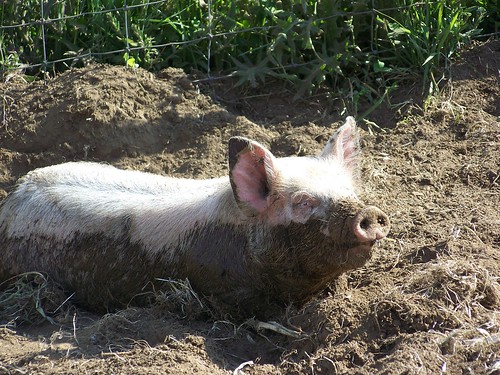
They are using some old fashioned labor to till and fertilize a new extension to the garden - pigs! They've got a pair of pigs and this year's piglets fenced into an area that was weedy and dry just a couple weeks ago. As you can see the piggies are enjoying their mud baths as they dig for roots and insects and enjoy fresh air and sunlight. That is going to be some vitamin D rich lard! I found it really interesting when Genevieve mentioned that another farmer asked about renting her boar to breed with their sow. Apparently it is virtually impossible to find old fashioned pigs to make baby old fashioned pigs because most pig farmers use artificial insemination to breed in "new and improved" characteristics into their herd. Genevieve, with her everpresent optimism and openness said, "Sure! Let me research how to do that!".

Pokrov Farm seems to be crawling with chickens. Happy, outdoor, bug eating chickens! They have two big barns that both have adult chickens in them as well as a big room full of baby chickens! When we were visiting the two housemates were working on a Joel Salatin style chicken tractor so that the babies can move out into the field as soon as they get their feathers. Genevieve was saying that they got hooked in with a Southeast Asian community that wants a couple hundred live birds a month so that they can butcher them themselves. What a great things for a small farm to have such a standing order.

In one of the chicken houses they have a Joel Salatin style rabbit set up with the wire bottom cages over where the chickens are. The chickens scratch the rabbit droppings and keep the area clear of insects that might bother the rabbits. One of my favorite parts of the tour was getting to see the brand new baby rabbits. One mama rabbit had kindled her kits a couple days earlier and the other had kindled the night before I was there. The babies were like little pink blobs with bunny ears.

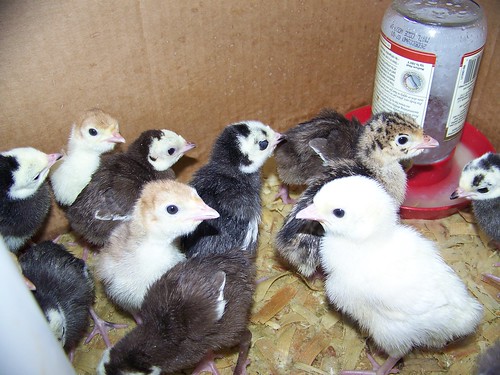
The other babies I got to see at the farm were baby goats, baby geese and baby turkeys. Genevieve ordered a mixed pack of turkey hatchlings so she doesn't even know what breeds they are. I ordered one for my thanksgiving dinner.... I'm not sure how I would feel about raising them from these tiny fluffy babies into dinner, but I'll be happy to eat them when they come my way! The geese were possibly the cutest things ever, but I didn't get a good picture. They were fuzzy and yellow, like cartoon ducklings. Genevieve is keeping a couple pygmy goats for milk and they had just kidded that week. I picked up one of the kids and it was tiny, like a puppy!

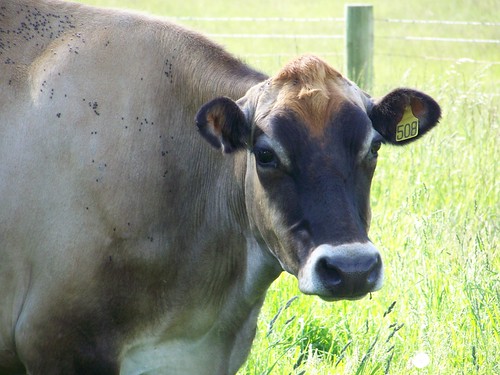
Genevieve's pride of the farm is her Jersey cow, Ella. Ella is producing milk that Genevieve is drinking and selling raw, as well as making cheese. She is planning on holding cheesemaking classes through the summer as well as other workshops. Genevieve was commenting on how they have been having a fly problem with Ella and are having a very hard time finding advice on how to treat external parasites without chemicals. She doesn't want to put poison on the animal that provides milk for her children. She did eventually find a method using pine tar and has the supplies on order.

Genevieve and her family are an inspiration to those of us with homesteading ambitions. She says she had been an urban homesteader in Portland, keeping chickens and digging up her lawn to plant vegetables. She and her husband saw an opportunity to move up a notch and have a real farm and have taken it. They are working hard and have lots more to go before they are assured a financially profitable farm, but they are supplying themselves with most of their own food. I am very proud to be able to support them this summer and have them support me! I can't wait to go out for a cheesemaking class or to harvest apples or fish trout in their pond. On top of it all, Genevieve is one of the most welcoming, optimistic and just plain sweet people I've met in a long time.

Now it's time for you to find a farm to go visit! Buy a CSA share, find someone producing raw milk or free range chickens! Go out there and meet your meat and veg with your veggies!

For more posts about REAL FOOD like the kind you get at small family farms check out the Real Food Wednesdays and Food Roots blog carnivals!

Friday, January 23, 2009

Goose Trois - The Potatoes

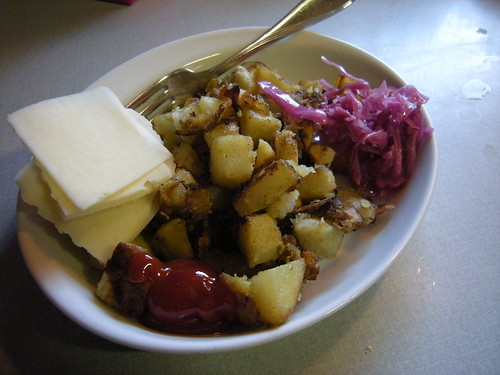
This is the part I was really looking forward to - potatoes fried in goose grease. It was everything I wanted and more.

To fry potatoes:

1) Cook a goose and render out 1 pint of goose grease.
2) Spend years seasoning a cast iron skillet until it has a perfect patina of use and fat.
3) Spend months developing the perfect, highly nutritious seasoning salt.
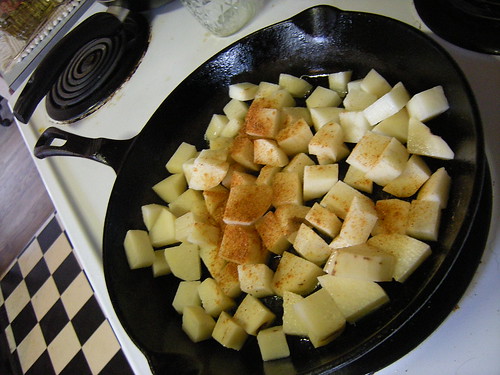
4) Peel, chop and cook potatoes in aforementioned grease in aforementioned skillet with aforementioned seasoning salt.

Easy, huh?


I used russet potatoes here and they turned out great. I do like yukon gold potatoes, and you don't even have to peel them. Use whatever you have avaliable.

I seasoned the potatoes, as I season all potatoes with my special, soon to be patented (not really, but maybe - know a patent lawyer?) chile grill salt. It is based on SN from Everything Free Eating's seasoned salt as well as about a million other recipes on Recipezaar. It is chok full of healthful spices and has such an unassuming flavor it can really be used anywhere. Sea salt includes many trace minerals not found in table salt. I use Real Salt, but other sea salts are just as good. Chiles and turmeric are full of antioxidants and cancer fighting nutrients especially needed when grilling or frying food. I use mostly New Mexico chile powder to keep the scovilles down, but a little Arbol or cayenne would kick up the heat nicely. I find Spice Hunter New Mexico chile powder at my local grocery stores. Kelp is a wonderful source of iodine and other sea minerals and doesn't add any noticeable flavors to this mixture. Onion and garlic are also known for their anti-biotic and anti-cancer properties. You just can't go wrong with this stuff!


Alyss' Chile Grill Salt
2 tablespoons sea salt
2 tablespoons paprika
2 tablespoons mild chile powder, or a mix of mild and hot powder
1 tablespoon turmeric
2 teaspoons kelp powder
1 teaspoon onion powder
1 teaspoon garlic powder
1/2 teaspoon nutmeg
1/4 teaspoon ground coriander
1/4 teaspoon ground cumin

Combine everything in an empty glass spice jar. Makes about 3/4 of a cup.


I served my potatoes with homemade sauerkraut, ketchup and cheese. Like I said, it was everything I wanted and more.

Saturday, January 17, 2009

Goose Deux - Apple Chestnut Stuffing

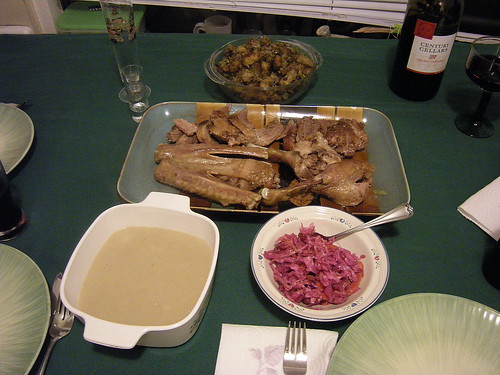
After carving this is how much meat one goose gives. It certainly isn't a turkey. I heeded the advice of food writers and made sure to make lots of stuffing and lots of gravy to fill up my guests' plates. Many of the recipes I read also said to actually stuff the stuffing into the goose. I know people have been doing it for forever, and geese are not as prone to nasties as chickens, but I just couldn't bring myself to do it. In the end, I'm glad I didn't because the stuffing wasn't completely full of goose fat so was a relatively decent foil to the greasy meat.
This recipe made 8 or 10 cups of stuffing but that turned out to be a goodly amount for the meal. It meant that we had lots to offer dinner guests that evening, and plenty of leftovers as well. Next time around I might even increase the bread cubes, add some more onion and just make a little more.

Of course, use sourdough or soaked flour bread if that is important to you. I used white bread, which is lower in phytates than whole wheat, and figured the whole meal was nutritious enough to call it good :)

Apple Chestnut Stuffing for a Goose
Serves 6-8

*7 cups cubed rosemary bread (or good quality white bread, but then add rosemary along with the other herbs)
*1 onion, diced
*3 celery ribs, chopped
*heart and liver from one goose, optional, or use chicken giblets. (I chose not to use the gizzard because it was so tough, but you might)
*1/2 cup butter
*1 tbs dried, ground sage, or 3 tbs chopped fresh sage
*1 tsp or so salt and pepper
*1 tsp dried thyme or 2 tsp fresh thyme
*1 tsp dried rosemary if you didn't use rosemary bread, or more fresh.
*2 granny smith apples, diced (recipe called for 2 cups, I just used two apples)
*1 can of chestnuts, rinsed and broken (can was probably 13 or 14 oz, or maybe 2 1/2 cups chestnuts. It was an odd sized can but the recipe could absorb considerbly more or less chestnuts depending on what you have avaliable)
*1/2 cup or so goose steaming liquid or chicken broth

Either dry the bread cubes over night or toast them in a low oven until quite dry and slightly golden.
Sautee the onions and celery in the butter until soft, 7 to 10 minutes. Add the chopped giblets, sage, thyme and salt and pepper and cook another three to five minutes or until the giblets are cooked through. Add the apple and the chestnuts and cook another 3 minutes or until the apple is just starting to get soft.
Combine the vegetables with the bread and mix thoroughly. Moisten the mixture with a little goose juice and pack into a crock pot or large casserole dish. I cooked mine in the crock pot on high for about two hours, but suspect it would take just around an hour in the oven to make sure everything is hot and the edges are starting to get a bit crispy. Some recipes used an egg to bind everything together but I found that occasional mashing and stirring of the stuffing the crock pot allowed it to bind a bit so it wasn't just bread cubes mixed with vegetables.

Friday, January 16, 2009

My Goose is Cooked

I finally did it. I've been talking about it for years. I finally cooked my Christmas Goose. Never mind that I didn't get around to it until January 11, he was still my Christmas Goose.

I bought a 10 pound Schlitz goose from a local meat market. Turns out Goosey is not local at all but they claim they are free range. Schlitz does offer a no-antibiotics brand of goose, indicating that their "plain" geese are treated but I still suspect that geese are a bit more humanely treated than most other fowl. I paid six dollars a pound, but I found the same damn bird at another market for a dollar a pound less two days after I bought Goosey.

I did a lot of reading over the last few months to figure out how to cook a goose. I read this article in the New York Times from December 2008, and this one from NPR in December of 2007 and this one from the Schlitz people themselves. In the end I decided to use Julia Child's method from The Way to Cook. It's a steam-roast method that sounded like the best way to get the fat out in a useable form and still have a tasty bird to eat. Speaking of fat... the first step when wishing to prepare a goose is to buy a new bottle of dish soap. Holy dear lord are they greasy lil buggers! :) From the moment I opened the plastic bag until well into the clean up and leftover-eating process I was up to my elbows in goose grease. On the upside, my hands have never been so soft ;)

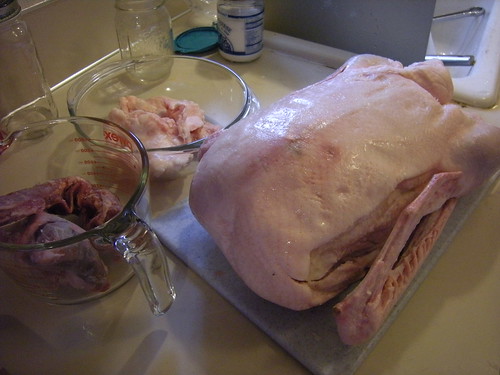
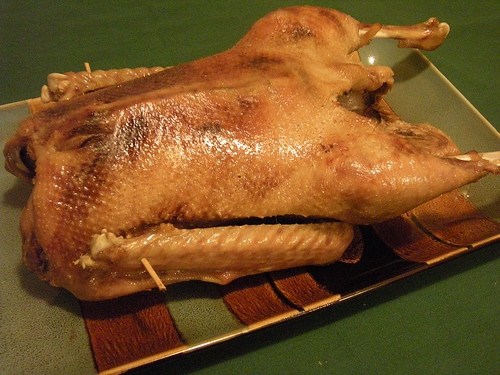
Here is Goosey right out of the bag. I removed close to two cups of fat pods from inside the cavity and from extra trimmed skin as well as the liver, heart, neck and gizzards. I trimmed the wing ends off (look at those long wings! This ain't no chicken - he can fly!) and used those and the neck to make some stock. The giblets went into the stuffing. I do think he's a handsome little, er, big bird.

The first step was getting Goosey ready for his steam bath. I pricked his skin, rubbed him with lemon and salt and then put him breast up in the roaster with a couple inches of water. I put the roaster on the stovetop, brought the water to a boil and let him steam for an hour. This method allows the fat to render out and both not drown the meat and still be useable. After the steaming I drained out the liquid from the roaster and got THREE CUPS of fat!!


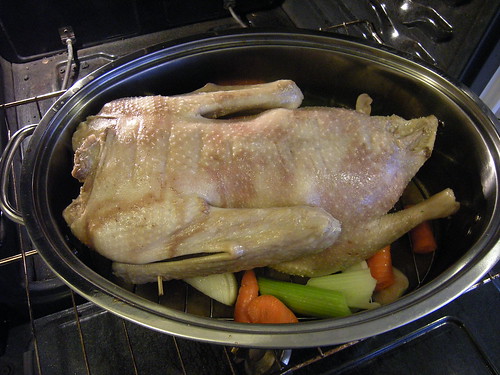
After the steaming I cleaned out the roaster and strewed some vegetables in the bottom. Goosey went back in, breast down, along with a cup of goose steaming liquid and a goodly splash of wine to spend two hours roasting in the oven at 350. Then the lid came off, the goose got flipped and another half hour to brown, with a little basting for good measure. More fat and liquid came out during the roasting ready to made one heck of a tasty gravy.

I used goose fat and butter to make a roux and then used the liquid from the roasting, seasoned with garlic powder and onion powder to make a gravy. Along with the meat and gravy I served an amazing Apple-Chestnut stuffing and some of my apple-cranberry sauerkraut. The consensus among the dinner guests was that goose is darn tasty, but very fatty. You really don't get much meat off a goose, but what meat you do get is very flavorful.

The real bonus of cooking a goose is the amount of "extra" food I have. Three cups of fat, plus maybe five cups of cooking liquid and another half cup of fat from that, all the fat from the cavity to be rendered and the carcass for more stock and probably more fat. Wow! Oh, right, and all the fat I wiped up off my counter and knives and hands and cutting board... haha. Did I mention they are greasy little buggers?

And for the rest of my life I get to tell the story of cooking my goose ;)