Wednesday, August 12, 2009

The Making of an Alewife

Almost two years ago now I met a very lovely man who I like to call the Brewmeister. The Brewmeister had recently come back from a 9 month program in Berlin to learn to brew beer but had previously thought about earning a bachelors in fermentation science at Oregon State University because he loved making wine and mead almost as much as he loved making beer. Before too very long the Brewmeister and I were cohabitating and fermenting like crazy fools. It wasn't all unicorns and rainbows so when spring rolled around this year the Brewmeister moved to Alaska and I kept a fair amount of his brewing supplies. Who said men are good for nothing? :)

This summer I have been putting the skills I learned at the Brewmeister's side to use in making my own beer and wine. Brewing alcholic beverages has an acient history and some say it might even have been the ultimate factor in humans deciding to stop wandering and set down roots and build a civilization. The theory is that people grew grains not to make bread but to make beer, and once you are making beer you need storehouses for the grain and the beer... plus pubs to drink it all in. Until the 1516 Reinheitsgebot, the German beer purity law, was enacted (and even well after it in many places) beer was brewed with a wide variety of grains and herbs, often by women in their own homes. On it's surface the Reinheitsgebot, which restricts beer ingredients to malted barley, water and hops (plus yeast, but that wasn't identified as a crucial ingredient until the 19th century) is a trade protection law to reduce competition with both local bakers and brewers in other regions. Digging a little deeper it probably also had anti-pagan, anti-"drug" and anti-women motives as well. Many of the old style beers were made with herbs that were psychotropic and used in ancient cermonies that predate the puritanical Christianity that was gaining popularity at the time. Hops, a common but not at the time universal bittering and preserving agent in beers, are actually a depressant and anaphrodisiac. People who drink hopped beer don't generally have the energy for all night frolicking like those who drank the ancient gruit ale. No matter the reasons behind the Reinheitsgebot the results were clear - a Teutonic culture of pure beer, made in factories by men using chemicals and precise measurements. This is how the Brewmeister tended to brew.

Being a disciple of Sandor Katz and uncounted generations of alewives brewing in their kitchens I have adopted a much more free flowing style. All of my experience making fermented vegetables had led to me have faith in the microbes. If you give them a reasonable place to set up shop, they will! My first beers were literally "a little of this, a little of that, throw in some yeast". Honestly, that first beer is quite drinkable. I did actually cave and buy a kitchen scale after the first brew day and my second beer is much better.

My first two beers are fir tip beers brewed with both hops and the young tips of Douglas Fir trees. Doug Firs are the state tree of Oregon and insanely common where I live. I collected the tips in March and April from trees growing my parents' yard and my everyday dog walk park. They have imparted a lovely acidic and tannic flavor to what would otherwise be a rather boring amber ale. Here is my recipe and instructions. These may look complicated but they are not. In fact, brewing can be a lifetime pursuit and there is always more to learn. But the first step is just brewing some.

The ingredients to make beer are neither expensive nor exotic. If there is a home brewing supply store in your town you are all set and if you don't I'm sure everything can be found online for a reasonable price. Right now I am making beer using malt extract which is basically a molasses or syrup made from malt sugar. The more advanced method of making beer involves extracting the sugar out of malted barley yourself. This involves considerably more equipment and skill but yields a much more complex beer. Malt extract is avaliable in many colors at home brew supply stores or over the internet. Hops are the other main ingredient in beer and both they and brewing yeast are also easily found at brewing supply stores. The variety of hop is not too important in this beer (some hops have lots of bitterness and little aroma, others the other way around) so get something middle of the road if the brewing supply folks ask what you need. I used an American ale yeast, but again it's not terribly important. Anything that isn't a specialty yeast will work just fine.

I will list out both the hardware and the software you need but you can certainly get away with less or load up on more, especially in the hardware department! I will give instructions for a one gallon batch as opposed to the more common five gallon batch because I think it is easier to start small. As soon as you get the hang of it, scale up. I highly recommend reading all the recipes, forums and books you can get your hands on (I highly, highly recommend Sandor Katz's Wild Fermentation) and then just give it a try. Remember, the yeast will make alcohol, all you are doing is setting the table for them.

****

Broderick Cellars Fir Tip Ale


Step One: Brew Day

Hardware:
*Cooking pot with a lid
*Stainless steel long handled spoon
*Cheese cloth or other mesh "hop bags" or a strainer
*Kitchen scale or other device to weigh a couple ounces of plant material
*A second pot or 1/2 gallon glass jar
*A small glass jar, coffee mug or pot
*Timer
*Funnel and strainer
*1 gallon glass jug - this is called a carboy or fermenter
*Air lock and stopper
*A stove or other device to heat water to boiling and keep it there, as well as running cold water, *A tub of ice water or some other way to cool a volume of liquid relatively quickly.

Software:
*Pale or amber malt extract - 1 pint (it is usually sold in 7 or 14 pound tubs. It stores forever so don't worry about buying too much)
*Hops - 20 g of whole hops (Any variety that is not a specialty bittering or aroma hop)
*Fir tips - 40g (Be sure to collect only the young, soft, light green tips. They have a lovely citrusy, christmas tree smell but less tannin and bitterness than the older, dark green tips. The young tips of any edible conifer would do. Spruce is traditional but many pines are edible too)
*1 packet of dry ale yeast (Don't let them talk you into "pitchable yeast". Since you are making a 1 gallon batch you want to be able to use less than a whole packet. Any American or non-specialty yeast will do)
*Good drinking water. People always claim that their water is the reason their beer or wine is so good. If your tap water is icky, buy bottled water. Or better yet, find a well or a spring.

Method:

Start heating a half gallon plus a pint (10 cups) of water in a good quality cooking pot and 4 cups of water boiling in a second pot. Measure out your hops and divide them into two hop bags. One bag should have 15g of hops in and the other one should have 5g. Measure out the fir tips and put 20g in a third hop bag and the remainder in your glass jar or other container that can hold at least cups of water. When the smaller pot has come to a boil pour the boiling water over the fir tips in the jar and let steep. This is your fir tip tea.

As the larger pot of water gets hot pour in the malt extract. Carefully swirl hot water in the measuring cup to get as much malt out as possible. Stir to help the malt dissolve and pull out one cup or so and put that in your coffee mug and allow it to cool. Continue stirring or watching the pot until it comes to a full boil. It may get frothy so be careful with it. When it is boiling add the bag with 15g of hops and the bag with the fir tips in it to the boiling malt water. Stir or push them under the water and then put the lid on the pot and turn the heat down to where it maintains a strong simmer/low boil, but isn't boiling over. (OK - they say you shouldn't boil your wort with the lid on because it can cause off flavors. When I boiled with the lid off I had such great loss of volume I had a hard time topping it off. Read some other recipes and do whatever feels best to you). Again, be careful because all the sugar in the water may cause it to boil over. Set your timer for 55 minutes.

Check the coffee mug of sugar water to see how cool it is. When it is body temperature - when you touch it it feel neither cold nor warm - pour approximately 1/2 tsp of the dry yeast into the cup. Let the yeast dissolve into the sugar water and start to feed and bloom. By the end of the boiling period your yeast should be starting to get frothy and it should smell like yeasty bread batter. Fold up the packet, put it in a zip top bag and store it in the freezer until you need more.

Clean your carboy and funnel with hot water and soap. Many brewing books and experts suggest sterilizing with bleach water. Sandor Katz and I say cleanliness not sterility. Stephen Harrod Buhner, author of Sacred and Herbal Healing Beers uses a hop tea to disinfect his brewing supplies. Do whatever makes you feel most comfortable.

When your timer goes off drop in the second hop bag, reset your timer for 5 more minutes and put the lid back on. When the timer goes off a second time turn the heat off and start fishing out the hop bags with your stainless steel spoon. Use a second spoon or some tongs to squeeze as much liquid out of them as possible and set them aside (don't forget to empty and clean them as soon as they cool. Ask me how I know).

Fill your sink with cold water or ice water and put the pot, with the lid on, in the sink. Stir the wort (as your unfermented beer is now called) with a clean spoon, and swish the cold water around to cool the wort quickly. You don't want to get any of the water into the wort so keep the lid on. If your fir tip tea is not cooled to body temperature then put that jar in the cold water and swish it around too to cool it off. When both liquids are body temperature or a little cooler, around 80 degrees F, then pour them through a strainer and a funnel into your jug with the yeast. Pour the wort first, splashing it around a bit, then the yeast, and top off with the fir tip tea. Fill the air lock with water up to the fill line and pop the stopper on top of your jug. Put your jug in a dark place with a stable temperature and clean up. Don't forget those hop bags! Brewing day is done!

The next morning check your beer to make sure active fermentation has started. The air lock should be bubbling away and there should be froth on top of the beer. If there is not active fermentation by 24 hours then proof another 1/2 tsp of yeast in warm sugar water and add that to the wort. It'll be fermenting, though, don't worry. Let it sit for 3-4 weeks until primary fermentation is finished. You will know it is ready for bottling because there will be a clear layer of yeast at the bottom of the jug and it will take about 2 minutes for a new bubble to come up out of the airlock.

Step Two: Bottling Day

Hardware:
*Plastic tubing or racking cane (tubing with a stiff end specifically designed for siphoning beer or wine)
*A second one gallon jug or a cooking pot that will hold 1 gallon (a second jug is a much better choice)
*6 22 oz beer bottles or 11 12 oz bottles. I prefer the ones with a flip top because then you don't need caps and a capper. If you don't want to spend for the flip top bottles you can reuse beer bottles that were not twist tops. Buy a capper and caps at the same supply house you bought malt and hops at.

Software:
*4 oz by weight of malt or corn sugar, or white sugar. That's 4 tbs malt sugar, 2/3 cup white sugar or 3/4 cup corn sugar. The malt or corn sugar can be bought at the brew supply store or sometimes for a whole lot more money at a health food store. White sugar gives a different flavor, but certainly can be used.

When primary fermentation has slowed (layer of yeast on the bottom of the jug and about 2 minutes between air lock gurgles) you are ready to bottle your beer. Start out by washing and santizing your jug, bottles and racking hose. Again, use hot water and soap, bleach or hop tea as you see fit. If you using bottle caps instead of flip top bottles be sure to read up on how to use them.

Heat about a cup of water in a small pan on the stove and stir in the sugar. Bring to a boil to dissolve and sterilize and then let cool a bit. Pour the cooled sugar water into the clean second jug. This sugar is going to mix with the beer and give the yeast a second wind in the bottles forming carbonation.

Bring your fermenting beer out of the closet and put the jug on the counter with the second jug on the floor or a bench below the counter. Insert the racking cane into the beer and either follow this guy's instructions for sterile siphoning or do like I do and swish your mouth with scotch and suck the beer into the tube. Have a glass handy to pour the first bit of beer into and then put the end of the tube into the jug with the sugar water in it. Try not to let it bubble and slosh too much, but you can gently stir the beer to mix it with the sugar water. As the beer is siphoning into the second jug get your bottles all lined up in the sink or on a easily cleaned surface lower than your counter. Taste your uncarbonated beer from the glass. How does it taste? Anything short of disgusting and you are well on your way to good homebrew.

When all the beer, but not much of the yeasty sediment, is in the second jug put the airlock back on the first jug and bring the second one up to the counter. Insert the racking cane and start the beer flowing again, this time into the bottles. Again, try not to splash or slosh the beer as you fill the bottles to within an inch or two of the top. With only 6 or 12 bottles this won't take too long and you can flip the flip top when you are done (or use a capper to cap them, which won't take too long either). Rinse or wipe your bottles off and stash them away in a dark, coolish spot and clean up.

The yeasty sediment in the bottom of your fermenter can be saved and used for your next brew. Swish the yeast and leftover beer together and pour into a glass jar with a tight fitting lid. Stash it in the fridge and on next brew day wake the yeast up by mixing the contents of the jar with warm sugar water while you boil the wort. You may never have to pay for ale yeast again!

Store your bottles in a dark spot with a stable room temperature. During the next three weeks the yeast will eat up the sugar you gave them and produce carbon dioxide to carbonate the beer. After 2 or 3 weeks pop a bottle in the fridge overnight to chill and open it to taste it. If it's carbonated put the other bottles in the fridge and drink up. If not, either drink the beer (it's still homebrew!) or pour it on your compost pile and wait another week to try again. Darker beers will continue to age over time while lighter beers are more at risk of spoiling. I've had some of this beer in the fridge for 2 months and it is still changing flavor and still getting better. The worst thing that can happen is it doesn't taste good anymore and you'll need to brew another batch.

***

So there it is, one alewife's guide to brewing a 1 gallon batch of beer. I highly recommend reading Wild Fermentation and Sacred and Herbal Healing Beers as well as spending time on the homebrew forums or chatting with the fine folks at your local brew supply store. You'll learn lots more about brewing beer and maybe figure out some better ways to do it!

Brewing beer is not that difficult. In a future post I will talk about making wine, which is a very similar process. Wine is possibly easier to start but takes months, if not years, to finish and age. Beer takes a little more work up front but is ready to drink is just over a month. In the end it is all just setting a table and inviting the right yeast to the party. It's not hard, it's not expensive and the results are well worth it. Even a middling homebrew is better than a fine commercial beer.

Prost!


Friday, July 24, 2009

Roly Poly, Daddy's Little Fatty

I never bought into the whole low fat diet thing. My parents didn't buy into it and it just never made any sense. Why would you want to eat margarine, which comes from a factory, rather than butter, which comes from a cow? Why eat sugar and preservative laden low-fat cookies when you could just eat real cookies in moderation? When I read Sally Fallon's Nourishing Traditions I finally had some words and some ideas to back up my vague feelings that a low fat diet was inappropriate. Fat isn't evil... in fact, fat is necessary for health and hapiness!

Traditional cultures have always prized fat because it is calorie dense and nutrient dense. From early American and European pig lard to SE Asian coconut oil to Inuit seal blubber fat has been the most sought after and important food stuff around the world. There's a Nature episode where Julia Roberts visits the nomadic people of Mongolia and learns about their culture. My favorite part of the show is how in one frame she is commenting on how gross the traditional butter tea is and in the next wondering how they survive such bitter cold temperatures. It didn't occur to her than the one is directly related to the other.

But in modern America something went wrong and has drastically changed how we view fat. In the middle of the 20th century a number of researchers promoted substituting unsaturated vegetable oils for traditional saturated animal fats and lowering dietary fat intake in general in order to reduce coronary heart disease. One of the best known of these researchers was Ancel Keys who published what became known as the Seven Countries Study which corrolated the lower fat diets of Post World War II Europe and Japan with that of affluent post war United States. Keys' statistical strong association weakens when other countries are added to the Seven, and almost fall apart completely when one takes into account that the Italians and French he studied had a long tradition of animal fats that had simply been put on hold by the devastation of decades of war.

In his New York Times piece What If it's All Been a Big Fat Lie Gary Taubes goes over the science and pseudoscience behind low fat and low carbohydrate diets (his research point to pro low carb and anti low fat diets). He lays out a very convincing story that a combination of imperfect human researchers and impossibly complicated human bodies have led us down a path towards obesity and disease. There is also more and more evidence that our modern diet is excessively high in polyunsaturated fats which are not a part of traditional diets. Polyunsaturated fat in the form of vegetable oil is cheap to produce and with the advances in chemically separating the oil from plant seeds, removing toxic chemicals and deodorizing the oils it has become a staple in every American home, restaurant and food processing plant.

Low fat, high fat? Unsaturated, mono-, poly-, just plain saturated fat? Omegas and LDLs and all that... what's a girl to do? Look to the past, that's what I always say. What would people use for cooking fat if they didn't have mono-cropped soy beans and giant food processing factories?

Using this criteria I have put together a fat primer for you. I present it to you with the reminder that we all do the best we can with what we have. I eat out sometimes, I eat at people's houses sometimes and sometimes I even get a pack of chips out of a vending machine. I am not a whole food Nazi, but when I can I prefer to use the most healthful, traditional cooking fats. Here's what I do in my kitchen... on my best days.

******

Fats for Cooking by Type of Fat

Unrefined coconut oil: This is the work horse of my cooking fats. It is almost flavorless and can be used at pretty high temperatures so I use it anywhere you would use "vegetable oil". It is solid when the weather is cool and liquid when room temps are above about 70F but since it comes in a wide mouth jar I just use a spoon to get it out. It's a little spendy to use for deep frying, but it would be good any other time you are cooking with fat. I usually buy Omega Nutrition brand but that's just because it's available at a good price at my local health food store.

Virgin coconut oil: I treat this as a special fat with amazing antimicrobial properties in addition to lots of medium chain fatty acids and a fantastic smell. It is pretty expensive and cooking might destroy the beneficial properties so I cook with it when I am doing something where coconut would be appreciated, like Thai curry. I melt it for use in baked goods occasionally when the flavor would be appreciated and use it along with butter on my popcorn. And sometimes I make coconut bark. Yuummm. I also use it for a number of body care products like skin cream (coconut oil and jojoba oil with a little scent) and deodorant (coconut oil and baking soda with scent). I buy pint jars at my health food store, but lots of people like Wilderness Family Naturals for 5 gallon buckets.

Butter: Mmm... butter. In addition to slathering this on bread and pouring it over popcorn I do cook with this occasionally. I use it, often mixed with coconut oil, when pan sauteing veggies or frying eggs. Butter does have some amount of water and protein in it so it will burn, but I don't have major problems with that. Ghee or clarified butter is an all purpose cooking fat in French and Indian cooking and can easily be bought or made at home. Raw, pasture raised butter is best but even regular store butter is better than margarine or vegetable oil. Look for imported butter like Kerrygold from Ireland or Anchor from New Zealand. Organic Pastures has a "pastured" butter and most stores sell organic butter these days.

Rendered animal fat: I am still working my way through the 3 pints of goose grease I rendered when I cooked a goose last winter. It's pure white, about butter consistency and has a slight poultry flavor. I enjoy cooking with this anywhere it's flavor would be appreciated or tolerated. I've also used chicken fat and would gladly use lard or tallow if I had it available. Each of these will have different flavors and smoke points but all would be good for general cooking (sauteing veggies, frying onions, browning meat, etc). A note on rendered animal fats.. these are not fats you can buy at any old grocery store.

Do NOT buy lard from a regular grocery store. The stuff they sell there is usually adulterated with hydrogenated lard and preservatives. It is not much better for you than crisco. These are fats you need to produce at home or buy from a specialty dealer/farmer. Of course, these fats are best from pastured, organic,happy animals but even grocery store chickens will make fat that is better than hydrogenated lard. You can save scraps from the meat you eat, skim fat from stock making or see if you can buy un-rendered fat from a butcher or farmer. Google around for instructions on rendering it yourself. It's not hard and the rendered fat will keep in jars in the fridge or freezer for a very long time.

Bacon grease: I collect bacon grease and keep it in a mason jar next to the stove. I use it for cooking anything a bacony flavor would be appreciate - which is lots of things. It's the best for starting soups or frying eggs. Mmm...bacon grease. And someday I'll get it together and make that bacon grease mayo recipe that's been floating around....

Olive Oil: Olive oil one of the few traditional liquid oils and is the classic oil for mayonnaise and flavored dipping oils. Buy the best quality you can afford because olive oil is subject to going rancid if not stored properly, and is probably much more adulterated than we would like to think about. It really shouldn't be cooked with. I do, sometimes for flavor, but rarely. Olive oil is much better for you when used in salad dressings or other raw applications because the monounsaturated fats are much more delicate than saturated fats. Extra virgin is the most flavorful, but feel free to use not-extra-virgin as long as you are using oil from a reputable producer.

High oleic sunflower oil: I just found this in the store, finally! It is a high monounsaturated fat oil that should be as healthful as olive oil, but with a different (less olivey perhaps?) flavor. I haven't opened the bottle yet so I can't tell you what it's like but I would use this anywhere I would use olive oil. It would be especially nice for mayo or other salad dressings where you don't necessarily want the olive oil flavor.

Spectrum palm shortening
: I bought this years ago and found it tasted horrible.It is made of deodorized palm oil and is low in polyunsaturated fats, so should be an acceptable fat. Probably a compromise fat because of how processed it is, but low in bad fats anyway. They say it can be used anywhere regular shortening would be used but the pie crust I made with it tasted like soap. Anytime I've used it for cooking I've also gotten a gross soapy flavor. I used it to season my cast iron pans last winter, and sometimes throw a glob in a wiped out cast iron skillet to grease it up and protect it. I might try it on a BBQ sometime. too.

Sunflower, safflower, sesame oil: I have bought these oils in small bottles to make salad dressings with. They are all higher in polyunsaturated fats than we would like to be consuming (especially since I probably still get a fair amount of poly unsaturated fats from factory farmed meat, eating out, eating at friend's houses and occasional packaged foods), but sometimes you have four heads of lettuce in the fridge and really don't want an all olive oil salad dressing. Now that I found the high oleic sunflower oil I won't buy these guys anymore. When looking at bottles in the oil isle at the health food store look for oils with the lowest polyunsaturated fat level and the highest monounsaturated fat level.

Red Palm Oil: I've never used this but I hear it's pretty neat. It's solid like coconut oil and deep red in color. The color indicates a high level of carotene vitamins and the saturated fats keep it stable at high temperatures.

Canola oil: This stuff really is gross and the devil in so many ways. My roommate has a bottle of it that I moved to under the sink and he hasn't missed it because he hasn't cooked in months. I busted it out when I grilled the other weekend just because I wanted to have fun and it was easy. I drank a Budweiser that night too. So sue me! :)

******

Cooking Fats by Type of Cooking

Pan frying/sauteing: expeller pressed coconut oil, virgin coconut oil, butter,bacon grease, rendered animal fat, olive oil. Depends on the flavor. Be careful with butter at high temps.

Baking: butter, virgin coconut oil or expeller pressed coconut oil. Depends on the flavor, and how the fat is used. I would use either, along with parchment paper, for "greasing" the pan.

Deep frying: you would want to use rendered animal fat like lard or tallow there. These fats have the highest smoke point so are able to get good and hot to fry the food without letting it get greasy.

Seasoning cast iron skillets: Lard if you have it, palm shortening or crisco. I believe that a long baking in the oven would polymerize the fat and turn it into a coating rather than a fat that gets into your food so this would be a way to use up that jar of crisco you still have. I use palm shortening or coconut oil to grease up a pan between uses if I am not going to actually bake the fat on.

BBQs or Grilling: Well... yeah, about that. I still use canola oil for this. Expeller pressed coconut oil should be fine because of it's high smoke point, but it's awfully expensive for swabbing all over a grill top. I might try the palm shortening next time. I think ideally you would have a slab of un-rendered pork fat to rub all over the grill :)

******

There is lots of good information out there about which fats to use and why. Check out all the links I used in this post and then check out the following resources:

*Weston A. Price Foundations Know Your Fats Index

*Cheeseslave's and Kelly the Kitchen Kop's Posts on Fat

*Nina Planck's Real Food book

*Bryan's Blog Stay Healthy, Enjoy Life. Specifically his post about fats.

Fat is a prized food for a reason. It is full of vitamins, energy giving calories and protective molecules. Remember, every cell in your body is encased in saturated fat and your brain is mostly saturated fat. The hormones that make you happy and sexy are made of saturated fat. Don't sell yourself short by going low fat or eating unhealthy, non-traditional fats.

Be sure to check out Real Food Wednesday for more posts from folks who aren't afraid of fat!! Also, be sure to click on all the photos I used to see more from my amazing, not fat-a-phobe, Flickr friends!

What fats do you cook with at home? What's your favorite way to get more fat into your diet? Whats the best butter you've ever tasted?

Tuesday, June 23, 2009

Of Probiotics and Pickles

If you are in anyway connected to the world you've probably heard more and more about probiotics and beneficial bacteria. People are selling probiotics as pills, liquids, juices, yogurts and other fanciful items. Most of you have probably seen the yogurt commercial with the slightly disturbing animation of an arrow on a woman's stomach and you might even be able to hum the jingle for that product. What's all the big deal about probiotics anyway? And do we really need to spend top dollar to have them added to our foods?

The term probiotics refers to bacteria and yeast found in food that are good for your body. Our skin and intestinal tract are completely covered in bacteria and the idea is that inviting the right kind of bacteria into that system has health benefits. The human gut can contain over 2 lbs of intestinal microflora (beneficial bacteria) and they do some pretty important work there. They help digest food and create vitamins, they make it hard for bad bacteria to live there and stimulate the part of our immune system that is in our digestive system. In fact, there is more and more evidence that everything from acute intestinal upset to allergies to autism can be helped by normalizing gut bacteria and using probiotics. There are lots of good commercial probiotic foods and supplements available (as well as some not so good ones) but being the DIY kinda girl I am, I like to make my own.

Yogurt, kefir and buttermilk are all very common probiotic foods. These are all fermented dairy products that are eaten while the bacteria are still alive. Vegetables and fruit can also be cultured into probiotic foods through a process called lacto fermentation. A couple months ago I wrote a tutorial for making sauerkraut, one of my favorite kinds of lacto fermented vegetable. Sauerkraut is a great way to start in on fermented vegetables because most Americans at least know what sauerkraut is and many even already like it. I've been surprised at how many of my friends are excited to try my sauerkraut because they grew up eating sauerkraut. Sauerkraut is not the only pickled vegetable out there so don't despair if you don't like the kraut.

Vegetable pickles are possibly even easier than sauerkraut and allow for as many variations as your imagination can come up with. The basic idea is to cover vegetables with a salty brine and allow the bacteria to do their thing. I'll give you a recipe-tutorial for my very favorite pickled vegetable recipe and list some of my favorite variations here and then I'll answer some common questions in a follow up post.

* * * * * * * * * * * * * *

Spicy Carrot Pickles


I like Spicy Carrot Pickles so much because they come out great every time. They are salty, spicy and a bit sour and always have a great texture. You can adjust the amount of spiciness to your liking using different kinds of peppers. These are based on the pickled carrots usually served at autentico taco places so they should be sort of familiar to a number of people.

Step One: Jar and Vegetable Prep

Find a glass jar with a tight fitting lid. A pint sized mason jars with a metal or plastic lid is great but an old pickle jar work just as well. Wash the jar and lid with hot soapy water and rinse well.

For a pint (two cup) jar you will probably use 1 1/2 - 2 medium carrots, 1/2 an onion, 2 cloves of garlic and half of a jalapeno. Have more carrots available in case I am underestimating and adjust the garlic and pepper as your family would like. I find half a jalapeno adds heat but is not blinding, but you may have widely different tastes. You can use a hotter pepper like Serrano or Habanero (if you dare) or a milder pepper like an Anaheim, a Hungarian pepper or a pizza pepper. Be sure to adjust the "half a pepper" accordingly to the size and heat of the pepper you choose. You could also use a pinch of red pepper flakes instead of fresh peppers.

Wash the carrots but don't peel them. Slice them into long ovals by slicing on a steep diagonal to about 1/4 inch thickness. Peel and slice the garlic cloves and slice the onion longitudinally (from pole to pole, not around the equator) into 1/2 inch slices or into chunks. Slice the jalapeno into rings. Layer the vegetables in the jar to within an inch of the threads.

Step Two: The Brine

There are all kinds of recipes out there for brine strength ranging from a specific measurement in the jar to percent salinity. After reading The Ultimate Kimchi recipe and Wild Fermentation by Sandor Katz, I decided to do this the old fashioned way - use my taste buds.

I make a brine by adding salt to water until it is "too salty to be tasty, but not salty enough to make me gag." I understand that this is a very vague description of how much salt to use, but it works. I promise. Start with a teaspoon in a pint (two cups) of water and taste it. You can hardly taste the salt, right? Add another teaspoon and taste again. Then increase by half teaspoons until the water is really gross. Add a splash of water and taste again. Somewhere in between tasty and gross is the right amount of salt. It always seems a little saltier than seawater to me.

Oh - and use the right kind of salt. You should use sea salt because it is pure and has lots of trace minerals that are really good for you. I personally use RealSalt because it lists the trace minerals on the package and sells for a reasonable price. Other sea salts would be fine too. You can also use kosher salt or other salt as long as it has no iodine and no anti-caking ingredients. One caution about Celtic or grey salt - moist salt is sometimes known for carrying bacteria and mold that can ruin your ferments. If you want to use moist Celtic sea salt then you should bake it first until it is dry. Seriously, though, who needs to go through that much work for pickles. Just buy some lower quality sea salt for fermenting and keep the Celtic for sprinkling on your potatoes.

Once you have your brine made with the right kind of salt to the right saltiness then pour it over the jar full of vegetables. The brine should cover the vegetables but still be below the threads of the jar. Screw the lid on tight and set it on the counter to begin fermenting.

Step Three: Fermentation

Just like in the Kraut 101 tutorial I recommend you check your pickles every day and learn to look for signs of fermentation. The day after you make your carrot pickles open the jar and listen for popping, fizzing or hissing as you open the jar. Smell the contents and then taste a sip of the brine (you can take some out with a spoon or just sip it out of the jar like I do... but then again I'm pretty cavalier about things like that). Is it at all sour or fizzy or still just salty? Put the lid back on and let it sit out for another day.

It usually takes 2-5 days for signs of fermentation to really show up. Exactly how long depends on everything from the quality of your vegetables and the ambient temperature to whether you sacrificed to the proper deities. I'll address some of these variables in the next post and in the end it doesn't really matter how long it takes, just that it happens. Be patient, it will.

When your pickles are popping, fizzing or starting to taste sour then move them to the fridge. Carrot pickles usually taste best after another two or three days in the fridge (you should try them every day to see when you like them best) but will last for months without getting mushy or gross. The onion will start to get a little mushy after a month or so but whole garlic cloves are still virtually raw until at least a month in the brine.

I like to eat these pickles in anything even remotely Mexican in flavor. I love them in quesadillas and burritos as well as on salads. The pickle brine can really brighten up a soup and makes a fine salad dressing when substituted for vinegar in any recipe.

* * * * * * * * * * * * * *

Once you've run through this recipe once then you are ready to start thinking about pickling other vegetables. Here are some of my favorites.

Cucumbers: pickled cucumbers are a classic. I have used whole pickling cucumbers as well as sliced eating cucumbers (remove part of the skin, it is tough and bitter). Pack the jar with cucumbers, dill seed, garlic cloves, black peppercorns and maybe some sliced onion and/or mustard seed. Cover with brine and follow the steps above.

I didn't use cucumbers as my master recipe because I've had mixed luck with fermenting them. Cucumbers, being so watery, are at risk of getting mushy and even when they aren't mushy they never taste quite the same as vinegar pickles do. I like the fermented flavor but have not yet perfected the crunchy cucumber pickle. Some people add a grape leaf to the jar and others soak the cucumbers in salty water first. I'm going to experiment this summer and I'll let you know.

Turnips, Radishes, Not Spicy Carrots: Slice them into planks or chunks and cover with brine. Try these will dill seed and garlic or with mustard seed and red pepper flakes. Turnips tend to be a bit spicy when fermented, but are great on salads.

Beets: I recently made up a jar of sliced raw beets and carrots with no extra seasoning at all. The liquid is thick, sweet and deep red and the vegetables are now tender, sour, sweet. Fantastic.

Green Beans or Asparagus: Trim the veggies to fit in the jar and add a garlic clove and maybe one of those small, dried red chiles. Try doing the same with okra. A little juice from one of these jars is the secret to my Bloody Mary. Fantastic!

Mushrooms: White or baby 'bella mushrooms can be pickled in brine into a very tasty appetizer. I like to add black peppercorns and mustard seed as well as a small garlic clove. The mushrooms will float like corks but it has never seemed to be a problem.

Summer Relish: Last summer I made a jar of relish using canned corn, chopped green tomato, red bell pepper and onion with mustard seeds. It took a month or so for the flavor to develop but I was sad when it was gone. It was long past green tomato season and I've been daydreaming about it ever since!

Pickled Garlic:
Peel the cloves, fill the jar and cover with brine. It will take months (as in 4 or 5) for the cloves to ferment fully but it will be worth it. They ferment into this mellow, garlicky, almost sweet tangy condiment. Perfect for salad dressings and topping soup. And exceptionally good for you!

Of course you can mix and match. I almost never make a jar of just one vegetable, I use whatever I have around. I will often add turnips or carrots to sauerkraut, or get lazy and throw brine over cabbage as well. Give any vegetable you have a try in the brine and see how it turns out. Experiment with seasonings, garlic, onion and different flavor combinations. You'll be amazed at what you find you like. I serve pickled vegetables with almost every meal and pretty soon you will be too!

This post is part of the Real Food Wednesday Blog Carnival. Be sure to check out the other posts for more great real food ideas!

To see more photos of my lunches, others with home made pickles in them, check out my Flickr page.

Wednesday, June 17, 2009

Breakfasts of Champions

This last weekend I made two fantastic breakfasts for myself. I love a good cooked breakfast more than just about any other meal. Omlette with goodies tucked inside, hashbrowns or homefries, bacon, sausage, ham, hollandaise sauce! I lived with a boyfriend for a while who loved cooking breakfast as much as I love eating it and we got in the habit of eating bacon, fried eggs and toast even on weekdays. Now that I'm cooking for one again I rarely do that, but I do make a point to cook a good breakfast meal at least once on the weekends. Even better is going out for breakfast! I have heard that going out to breakfast is a real Portland thing and that means I'm a real Portland girl. I love breakfasts.

The first breakfast of the weekend was a puffy omlette with wild mushrooms. A friend from work gifted me some wild mushrooms that her friend had collected. Some were unquestionably morels and I happily sauteed them up but I wasn't sure what the other was. It might have been a king bolete but as I continued looking at it and googling like a mad woman I decided that I didn't really want to eat it. It was a little past it's prime, and mushrooms are just one of those things. Oh well, the morels were fantastic.

I read about puffy omlettes on this fantastic blog I found last week called Beyond Salmon. The author talks about her dilema in teaching a cooking class focused on eggs. She wanted to use authentic french methods to cook an omlette but it turns out no one likes flat, plain french omlettes. So she asked her mom how to make a fluffy omlette. Turns out the secret is a blender. I used her method, with some dill added to the eggs and the musrhooms and Irish cheddar inside. It was fantastic!


Mushroom and Dill Puflette


1/3 cup whole milk
2 1/2 tsp unbleached flour
2 large eggs
1/4 tsp salt
A few grinds of black pepper
A pinch of dried dill
Fat for the pan - a mix of butter and oil or butter and goose fat
2-3 Tbs of sauteed wild mushrooms and onions


  • Combine the eggs, milk, flour, salt, pepper and dill in a blender and blend until well combined. The original recipe calls for blending for 2 minutes, I didn't blend for anywhere near that long.
  • Preheat the broiler and set a a 6 inch cast iron skillet (recipe called for a 7-8 inch nonstick skillet). Add your cooking fat and let it heat until the butter has melted and the foam subsided. I used a goodly amount, at least a tablespoon total because I was worried about the eggs sticking but if you have a well seasoned pan you just need a thin coating.
  • When the foam subsides in the butter add the egg mixture into the skillet, cover the pan and cook for 45 seconds (maybe a full minute for the 6 inch pan) or until the eggs look set around the edges but completely liquid in the center.
  • Uncover and place the skillet 2-4 inches away from the broiler element until the mixture is puffy and golden on top, 60-90 seconds or until it is puffy and golden on top.
  • Add the filling, slide the omlette onto a plate and fold in half. The original recipe calls to "Dot with a sliver of butter, spreading it over the top of the omelette as it melts." How wonderful!

The next day for breakfast I just had simple scrambled eggs but accompanied them with a red flannel hash. Red flannel hash is a New England special of pan fried potatoes and beets with or without salty meat like corned beef or bacon. Mine had no meat but did have onion and lots of black pepper. This was really out of control good. Way, way better than I was expecting.


Red Flannel Hash


1 baseball sized beet, peeled and diced to 1/8 inch dice
2 baseball sized yellow potatoes, washed and shredded on a box grater
1/2 onion, sliced thin
salt, pepper
goose fat, lard or coconut oil for the pan


  • Melt the fat in a 12 inch cast iron skillet over medium heat and add the onions and beets. Lightly salt and pepper and cook, stirring occasionally, until the beets are tender.
  • Add the potatoes, more salt and generous amounts of pepper. Toss and stir until well incorporated with the beets and then smoosh the mass into the pan. Continue cooking over medium heat, stirring, scraping and turning occasionally, until the potatoes are cooked through and starting to get a bit crispy, about 20 minutes. Taste for salt and pepper and serve alongside scrambled eggs or topped with a poached egg.
Breakfast really is the most important meal of the day. Making sure that it is full of good fats and plenty of protein means you don't get hungry early in the day. A good breakfast keeps you productive and healthy AND happy. What do you like to eat for breakfast? .

This post is part of the Real Food Wednesday Blog Carnival. Check out what other folks are eating for breakfast, lunch and dinner over there!

Friday, June 12, 2009

I Tempted Her With Pheasant

Last month when I was at Kookoolan Farm I bought a pheasant from Chrissie. I've never cooked a pheasant before but thought it would be fun. Like my goose adventure, only with less grease! I find cooking exotic birds to be a bit less intimidating than cooking exotic beasts. They seem more accessable, and like with the goose I ended up with lots of 'extra food' from the pheasant.

Cooking a pheasant clearly should not be a just me for dinner kind of night so I invited some friends over. One friend hemmed and hawed because, it being a Saturday in June, she had three other parties to go to. I finally convinced her to come under false pretenses of homemade mead, but she was happy with pheasant and wine.

Pheasant is a dark meat bird with considerably less breast meat than a chicken. I looked at lots of recipes for roast pheasant and all of them called for wrapping the breast in bacon before cooking. Everything is better with bacon, isn't it? In the end, fearing a dried out, tough bird I opted to braise the pheasant instead of roast it. The recipe I used was a simple one and everyone loved the flavor. I added a split chicken breast in on top of the pheasant fearing there wouldn't be enough meat for all three of us, and though it wasn't necessary it was nice to have the leftovers. I would certainly use this reciepe again, with modifications found below.

Braised Pheasant
1 pheasant (plus a chicken breast or a few chicken thighs)
3 tbs flour
salt and black pepper
2 tsp dried rosemary
2 bay leaves
5 peppercorns
bacon fat and/or goose grease
1/4 cup red wine
1 1/2 chicken broth
1/2 a medium onion, sliced
4 cloves of garlic, smashed or cut in half
1 tablespoon flour
1/2 tsp ground dried rosemary

1) Cut the pheasant into pieces. I cut the leg/thigh pieces off, cut out the backbone and hacked the breast apart into two pieces. I saved the backbone, wingtips and trimmed neck and tail skin/fat for stock later. Preheat oven to 300 degrees.

2) Combine the flour with salt and pepper making sure the flour tastes seasoned. Rub the flour all over the pieces of pheasant. Heat the bacon fat and/or goose grease (lard or coconut oil if that's all you have) in a cast iron skillet. Brown the meat skin side down first until it is nice and golden brown. Do it in batches, making sure not to crowd the pan.

3) Place the browned pieces in the bottom of an enameled cast iron dutch oven (or other heavy pot with a well fitting lid). Be sure to keep chicken pieces on top of the pheasant as it doesn't need to cook as much. Tie the peppercorns, bay leaves and rosemary in a cheesecloth bundle and tuck in between the pheasant pieces. Add onion and garlic on top of the meat. Deglaze the pan with the red wine and pour that over the meat. Add the chicken broth and place in the hot oven.

4) Allow pheasant to cook for AT LEAST 2 1/2 hours. Probably more. When the pheasant is cooked through and the wing and leg joints move freely remove the meat to a platter and cover with foil to keep warm. Remove the onion and garlic either with a slotted spoon or by pouring all the sauce through a sieve and catching the liquid in a measuring cup, gravy separator or small saucepan.

5) Make the pan liquid into a gravy by cooking flour and ground rosemary in an equal amount of either fat that rises to the top of the pan sauce or more bacon grease. When the flour is cooked and starting to brown add the pan liquid into the roux and stir over medium high heat until flour is incorporated and the gravy is starting to thicken. Stir constantly and reduce heat to low when it is bubbling and thick.

6) Serve pheasant over wild rice, Israeli cous cous, orzo or mashed potatoes making sure to pass the gravy.

The cook is always most critical of their meal and my guests really enjoyed the experience. I found the pheasant to have a really pleasant flavor but it was tough. I braised mine for just over two hours and think another hour in the pot would have done wonders. A dry roasted hunk or meat or bird needs to reach the proper temperature but not go much above. A braised hunk of bird or meat needs to stay at the proper temperature long enough to melt connective tissue. I didn't give my pheasant enough time and it was pretty tough. I'll also add more rosemary next time. It was a lovely flavor and the original recipe called for branches of rosemary to be placed over the meat and liquid in the pot. I think that is a fantastic idea.

In the end, my guests enjoyed themselves. The gravy helped a lot (my trick to good gravy is to season the flour for the roux well with rosemary, basil, oregano or whatever other herb might fit the situation) and a couple bottles of wine with dinner helped even more. I didn't get any photos of the cooked meal, we were too busy eating it. Here is the lovely flower bouquet that was on the table.

I wonder what's next on my exotic bird cooking tour? Duck? Pigeon? Pastured turkey? Bring it on!

For more great blogs about cooking real food and why it's important check out this week's Real Food Wednesday!

Tuesday, June 2, 2009

Pokrov Farm Tour

If you haven't gotten out to tour a farm yet this spring then get yourself in gear! Spring on a farm is a fantastic time. The weather is nice (but not too hot, so the animal smells aren't overwhelming), the vegetables are pretty (but not overgrown) and best of all... there are baby animals everywhere!!

A couple of weeks ago I was lucky enough to visit Kookoolan Farms in Yamhill, OR and this week I got to visit Pokrov Farm outside of Sandy, OR. I met Genevieve, one of the farmers, through my local Weston A Price Foundation email list when she advertised that her farm had CSA shares available for the summer. I jumped on board and am eagerly awaiting my first CSA basket - it comes next week! I happened to be driving by her place last weekend and stopped in to meet her family and tour the farm.

Their farm is set on a hill outside of Sandy, OR on the flanks of Mt. Hood. They are leasing 35 acres of some of the most beautiful farm land in western Oregon. They have green meadows, big trees, a creek and a pond, a couple barns and a lovely farm house. I pretty much want to move in with them. Genevieve is deeply inspired by Joel Salatin and his farming methods and attended a workshop in Southern Oregon last fall that led her to find this farm for her family. She is now homeschooling her children as well as running the farm along with her husband and two housemates. They've only been on the land since November but already have a lovely vegetable garden, about a million chickens, a milk cow and a couple happy pig and goat families.

One of the housemates (forgive me, I've forgotten his name - though I'll probably learn it next week at the CSA pick up) is a certified Master Gardener and in charge of the vegetable patch. It looks like it's growing great with a wide variety of veggies, herbs and even some flowers growing. Have I mentioned that I can't wait for my first basket?

They are using some old fashioned labor to till and fertilize a new extension to the garden - pigs! They've got a pair of pigs and this year's piglets fenced into an area that was weedy and dry just a couple weeks ago. As you can see the piggies are enjoying their mud baths as they dig for roots and insects and enjoy fresh air and sunlight. That is going to be some vitamin D rich lard! I found it really interesting when Genevieve mentioned that another farmer asked about renting her boar to breed with their sow. Apparently it is virtually impossible to find old fashioned pigs to make baby old fashioned pigs because most pig farmers use artificial insemination to breed in "new and improved" characteristics into their herd. Genevieve, with her everpresent optimism and openness said, "Sure! Let me research how to do that!".

Pokrov Farm seems to be crawling with chickens. Happy, outdoor, bug eating chickens! They have two big barns that both have adult chickens in them as well as a big room full of baby chickens! When we were visiting the two housemates were working on a Joel Salatin style chicken tractor so that the babies can move out into the field as soon as they get their feathers. Genevieve was saying that they got hooked in with a Southeast Asian community that wants a couple hundred live birds a month so that they can butcher them themselves. What a great things for a small farm to have such a standing order.

In one of the chicken houses they have a Joel Salatin style rabbit set up with the wire bottom cages over where the chickens are. The chickens scratch the rabbit droppings and keep the area clear of insects that might bother the rabbits. One of my favorite parts of the tour was getting to see the brand new baby rabbits. One mama rabbit had kindled her kits a couple days earlier and the other had kindled the night before I was there. The babies were like little pink blobs with bunny ears.

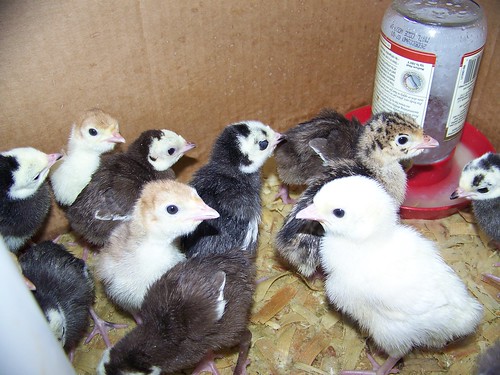
The other babies I got to see at the farm were baby goats, baby geese and baby turkeys. Genevieve ordered a mixed pack of turkey hatchlings so she doesn't even know what breeds they are. I ordered one for my thanksgiving dinner.... I'm not sure how I would feel about raising them from these tiny fluffy babies into dinner, but I'll be happy to eat them when they come my way! The geese were possibly the cutest things ever, but I didn't get a good picture. They were fuzzy and yellow, like cartoon ducklings. Genevieve is keeping a couple pygmy goats for milk and they had just kidded that week. I picked up one of the kids and it was tiny, like a puppy!

Genevieve's pride of the farm is her Jersey cow, Ella. Ella is producing milk that Genevieve is drinking and selling raw, as well as making cheese. She is planning on holding cheesemaking classes through the summer as well as other workshops. Genevieve was commenting on how they have been having a fly problem with Ella and are having a very hard time finding advice on how to treat external parasites without chemicals. She doesn't want to put poison on the animal that provides milk for her children. She did eventually find a method using pine tar and has the supplies on order.

Genevieve and her family are an inspiration to those of us with homesteading ambitions. She says she had been an urban homesteader in Portland, keeping chickens and digging up her lawn to plant vegetables. She and her husband saw an opportunity to move up a notch and have a real farm and have taken it. They are working hard and have lots more to go before they are assured a financially profitable farm, but they are supplying themselves with most of their own food. I am very proud to be able to support them this summer and have them support me! I can't wait to go out for a cheesemaking class or to harvest apples or fish trout in their pond. On top of it all, Genevieve is one of the most welcoming, optimistic and just plain sweet people I've met in a long time.

Now it's time for you to find a farm to go visit! Buy a CSA share, find someone producing raw milk or free range chickens! Go out there and meet your meat and veg with your veggies!

For more posts about REAL FOOD like the kind you get at small family farms check out the Real Food Wednesdays and Food Roots blog carnivals!

Wednesday, May 27, 2009

You can please some of the people all of the time...

and all of the people some of the time, but you can't please all of the people all of the time.

So the saying goes, and so it goes in the kitchen. As a relatively skilled and confident cook who primarily cooks only for myself I usually do pretty good with liking what I cook. I rarely have outright failures and I can usually find some silver lining even in my flops. The exception makes the rule, however.

Two months ago I bought a tub of chicken livers from Kookoolan Farms at our year round farmers market here in SW Portland. I had never cooked with chicken livers before and honestly never really eaten them either. I was a little intimidated but knew I would get around to them eventually.

Liver is quite possibly the most nutrient dense animal food on earth. Oysters may be a close second but liver is an amazing super food. Liver is chock full of vitamins A, B12, and folic acid. It is amazingly high in bioavaliable iron, copper, zinc and chromium. It contains nitrogen compounds that the body uses to produce DNA and RNA. It's also an amazing source of CoQ10. Seriously, this is some healthy health food.

Unfortunately, most Americans aren't very fond of organ meat. We didn't grow up eating it (possibly because our grandparents had to eat it during hard economic times and forced their kids to eat it who swore to never force their kids to eat it) and many folks think it is gross or dirty. There is also advice out there to avoid liver when pregnant because of it's high levels of retinol, a form of Vitamin A that seems to have been linked with birth defects.

Actually, even main stream nutritionists agree that an animal's liver doesn't store toxins, it just repackages them for storage elsewhere in the body. The vitamin A debate seems ridiculous to me. Native people ate liver as regularly as possible and no one died of vitamin A poisoning and if birth defects were common people would have stopped eating liver. The Wise Traditions article by Lynn Razaitis disucsses this issue in depth. She says that studies in Italy and Switzerland in the late 1990s, as well as almost all medical text books written before WWII indicate that liver is fine for pregnant women with doses of 30,000-50,000 IUs of Vitamin A. That's 4-5 oz of beef liver or 7-8 oz of chicken liver. She also quotes the Merck manual in noting that the few cases of Vitamin A poisioning are either due to synthetic vitamin A in multivitamins, or due to eating large portions of polar bear or seal liver. The synthetic vitamin toxicity was at doses 100,000 IU of vitamin A over many months. It takes about 10 oz of beef liver or 16 oz of chicken liver to give you that much vitamin A. Every day. For months.

I don't know about you, but I couldn't get 16 oz of chicken liver in me every day for a month. I couldn't get it in me over the course of a month if my recent liver experience is any indication. Remember how I said I don't usually have flops in the kitchen? Yeah, my chicken liver pate was a flop. I think it tasted exactly like it was supposed to, I just didn't like it. Here's the recipe I used. It's a variation on the recipe from Nourishing Traditions and I think it's a good one. It's just so, well, livery.

Chicken Liver Pate

3 tbs butter
1 lb chicken liver
1/2 lb mushrooms
1 medium yellow onion
2/3 c white wine
2 clove garlic
3/4 tsp ground dried rosemary
1/4 tsp ground dried sage
1/4 tsp crumbled dried organo
1/4 tsp dried dill
1 tbs lemon juice
4 tbs butter
salt and pepper

*Sautee the onion and mushroom, seasoned with pepper and a little salt, in 3 tbs of butter until soft. Add the liver, trimmed of the tendons and cook until firm but still barely pink on the inside. Add garlic and herbs to the pan then the wine. Cook over medium heat until the pan is almost dry. Let mixture sit until cool.

*Pour the liver and onion mixture into a food processor. Grind until a coarse paste and then add soft, but not melted, butter a spoonful at a time. Grind until smooth. Add the lemon juice and taste for salt and pepper.

This recipe actually had a lot of interesting flavor. I think in the future I would increase the herbs a bit but the mushrooms and liver really stood out. The problem is, well, that liver flavor. It's kind of metallic, and kind of earthy. But not in a good way. Luckily my roommate loved it and I found that I could get down a couple tablespoons at a time in a sandwich with radishes, cheese and mustard. I still have about 4 oz in the freezer. Maybe in a month or two I'll be ready to go back for round two.

Photo by These Days in French Life

Do you have a liver recipe you like? Have you ever eaten a liver pate that you really enjoyed? What do your friends, kids, spouse, housemates say about liver? Like runny egg yolks, I'll choke it down until I like it... it's just that nutritious.

For more real food recipes and tips check out the Real Food Wednesdays blog carnival!!

Sunday, May 24, 2009

Kookoolan Farm Tour

I think every kid should get to visit a farm at least once in their life, don't you think? I've been teaching a veterinary science class to homeschooled kids these last six months and recently made sure that these kids had visited a farm. It wasn't just any farm, it was a Kookoolan Farm.

Kookoolan Farm is a small, pastured based farm in Yamhill, OR about an hour outside of Portland. Chrissie and Koorosh, the farmers, keep three Jersey cows for raw dairy, chickens for eggs and meat and have a licensed poultry processing facility there. They also partner with what is becoming a co-op of farmers to get humanely raised, grass fed meat to paying customers in the Portland area. They are a really amazing, real food farm.

The first thing my students noticed was the 3 week old calf tethered in the front yard. He was born on the farm and was tethered out so visitors could pet him to gentle him. One thing I found really interesting was Chrissie's comments on her Jerseys being, em, insistent mothers. As a dog person this makes perfect sense. When we breed a strain of animals to do one thing we get a fair amount of "logical conclusion" behavior. For example, Labradors have been bred to retrieve and many labs have weird mouthy/eating/carrying things around behavior. Jack Russell terriers were bred to chase rats so we see obsessive chasing and visual stimulation behaviors. Well, apparently when we breed cows to do nothing but be pregnant or nursing we get some "logical conclusions" behaviors around mothering. Chrissie says one of her cows gave birth and the other two were mothering the one calf so aggressively that she had to buy two more calves from other local farmers. This is one of her teddy bear calves. He is 5 days old and he sucked on my thumb. Soooo cute!! Baby cows are pretty much adorable.

Next we got to tour the chicken houses. Kookoolan has had up to 500 chickens at a time, though this year they are running a slightly smaller operation. The hens are free range and roost and next in one of two large sheds with some feed along with the next boxes. She noted the symbiotic relationship between the chickens and the cows. They feed a little bit of whole wheat to the cows that they don't digest, but entices the chickens to scratch through the manure. For as many animals as there were in her small yard, there really was very little animal smell.

It was fun to see the different personalities of the different chickens. Some came right up to use to see if we had anything for us while others scattered as we came near. Chrissie is raising another 100 chicks in a brooder with the hopes of having them come into egg laying around Christmas, when her current layers will be on their winter break. This will provide her with a steady supply of eggs through the holiday season, when we humans like to eat eggs in things like pumpkin pie.

We also got to see the milking house and talk a little bit about raw milk production. In Oregon it is legal to sell raw milk on the farm if you keep only a small number of animals and don't advertise. The kids noted some chickens drinking some milk out of a pan on the ground and this led Chrissie to tell us about their testing procedures for the milk. They use the standard milk test of a somatic cell count to determine cleanliness of the milk. This count detects white blood cells in the milk which indicate an immune response in the animal. In Washington and California, where raw milk is legal and licensed by the state, somatic cell counts must be below 10,000 cells per mL, and commercial dairies that pasteurize their milk have an average somatic cell count of around 300,000 cells per mL! At Kookoolan farm if somatic cell counts are any more than a few hundred cells per mL the milk goes to the chickens. That morning Glitter, one of their milk cows was dealing with a cut on her leg which caused her cell count to be higher. The milk was probably perfectly safe for human consumption but like most small farmers Chrissie's product is either perfect, or not good enough.

Another thing that so impressed me about Chrissie and Koorosh is the partnerships they've been able to form with other farmers in their area. They are raising beef with their immediate neighbor who is now 70 years old and doesn't want to work as hard as he used to. He raises the calves on his land and Chrissie and Koorosh market the meat to real-food aficionados in Portland who will pay top dollar. They've formed a similar partnership with a neighbor across the highway who raises lamb. For years he was driving to Woodburn to sell his grassfed lamb for 85 cents per pound on the hoof. By partnering with Kookoolan Farm and tapping into the premium meat demand they are now commanding a considerably higher price, and actually making money on their lambs. Yet another farmer raises pheasants and turkey, and others allows Chrissie's meat chickens to be raised in their orchards and vineyards.

The most amazing part of all of this is that Chrissie and Koorosh have only been doing this since the fall of 2005!! Chrissie says she never even had a pet before they bought their first batch of day old chicks. They had never milked cows or butchered chickens. They were managers at Intel and are simply willing to take the risks required to start a farm. Chrissie says she works harder now than she did at Intel, but is happier and healthier by a country mile.

Every kid should get to visit a farm, and every person should get to eat food produced with as much attention and care as the food produced at Kookoolan Farms. You can see more of my photos from the farm visit on my Flickr page. Also, please check out their website for more information on their practices, their cheesemaking classes and their offerings. And then find a farm like them near you to get your own real food.

Wednesday, May 6, 2009

Greens, Greens, All the Meadow is Greens!

I didn't grow up eating greens. Honestly, I'm still getting used to the idea. As a kid we occasionally had spinach, though usually as salads not as a cooked vegetable. These days my dad is known to cook some napa cabbage I'm pretty sure he never cooked collards or turnip greens for us. We probably wouldnt've eaten them.

My first real introduction to greens came a number of years ago when I was working at a school with an organic garden. The woman who had planted the garden had planted about a dozen kale plants and they survived right through the winter. No one I worked with particularly liked kale and the plants were a bit aphid infested so we didn't want to donate them to the food bank. Being the poor AmeriCorps member that I was I decided to take these giant leaves home and see what to do with them.

I consulted my favorite source for basic cooking instructions - Cook's Illustrated. They recommended a steam sautee method where the greens are cooked over or in a small amount of water and then sauteed in flavored oil. Yeah, that's good stuff. Especially when that flavored oil is bacon grease.

This method works particularly well for hearty greens like kale, collards and turnip greens. I prefer a simple sautee for tender greens like chard and beet greens.

Last year as I was learning about edible plants I kept running into a lot of plants referred to a potherbs. These are green plants who's leaves are best eaten cooked as opposed to salad greens. As some of these "potherbs" showed themselves this spring I realized it was time to learn to love greens.

Nettles and comfrey are two greens that grow abundantly in my neighborhood and have found their way into my kitchen recently. I experimented with nettles earlier this spring and love their flavor but hate having to deal with them. They taste minerally and are wonderful well salted. Last week I harvested some comfrey that I had scouted out last summer but hemmed and hawed over eating at that time. Many sources note that comfrey contains chemicals called hepatoxic pyrrolizidine which can cause liver damage. Susun Weed speaks eloquently about how comfrey has gotten this, in her research and experience, undeserved reputation. The basic gist of Susun's article is that the toxic chemicals are found in the wild comfrey, not the cultivated one, and even then mostly in the roots and to a lesser degree in the stems and leaf ribs. The tipping point for me was when I saw comfrey listed in my Joy of Cooking as an eating green. Sauteed greens, here I come!

Steam-Sauteed Hearty Greens

1 bunch of kale or collards or mustard greens or comfrey or a mix
2 cloves garlic, sliced
1 tbs bacon grease, or olive oil, or coconut oil
a shake of red pepper flakes
a pinch of salt
a dash of red wine vinegar

*Clean the kale and remove the leaves from the stem. Chop or tear the leaves into fork sized pieces. Heat a couple inches of water in a pan big enough to hold all of the kale. When it is boiling add the greens, stir a bit with a wooden spoon or tongs and cover. Let the kale steam a minute up to five then drain in a colander.

*While the kale is draining and drying a bit heat the fat in a sautee pan or wok. Add the garlic and red pepper and cook until the garlic is starting to brown a bit. Add the kale and toss and turn with tongs. Cook until the kale is fully incorporated with the flavored oil. Sprinkle with salt and then finish with vinegar.

I used the same steam-sautee method with the comfrey as I do with kale only made sure to cook it well in the water first. With kale I only steam it until it changes color but I made sure the comfrey was cooked through. I also made sure to harvest the smallest leaves I could find and remove all the ribs from the leaves. It was just a gut feeling, but I went with it. Wild vegetables are not terribly interested in you eating them, so it's best to treat them respectuflly. I sauteed it in refined coconut oil with some garlic and chipotle flakes. It was fantastic.

If you haven't grown to love greens yet start with chard. Chard is a sweet, tender little green with hardly any of the bitter flavors or odd texture other greens can have. Use plenty of garlic, bacon or other good cooking fat and a goodly splash of vinegar right at the end. You'll be enjoying greens and ready to move on to potherbs in no time. And if all else fails, eat them with macaroni and cheese. You can handle just about any vegetable mixed with macaroni and cheese.

For more great recipes and real food ideas check out the Real Food Wednesday blog carnival!