Tuesday, March 31, 2009
Something to Stew Over
Wednesday, March 25, 2009
Square Foot Gardening

For this week's Real Food Wednesday blog carnival I'll tell you a bit about my gardening experiment. I've been wanting to garden for years but the school/seasonal job year happens to perfectly bisect the growing season year. It's hard to get excited to plant stuff in April and May when you know you are going to be moving in June or July. Luckily for my gardening aspirations I have a "real" adult job this year and no plans of moving anywhere! I am
actually going to be planting two gardens this year, one in the little yard at my duplex and a bigger one in my parents' backyard up the street.Sunday, March 22, 2009
Blender Batter: Cornbread
When this happened to me last week I did, at least, have one shining beacon of hope. In addition to putting black beans in the crock pot I had started a batch of Sue Gregg's Blender Batter Cornbread. You knew the blender batter method made great pancakes (because I told you it did and you all ran out and tried it this weekend, right?) but did you know it makes an amazing cornbread too? It does! Sue's recipe calls for whole kernel corn and wheat berries processed the same way as for the blender batter pancakes. I didn't have any wheat berries in the house so I used white flour, which is lower in phytates than whole wheat (if you are really worried about
Be sure to check out Sue's recipe and then read on to see how I modified the recipe. Also, a chilling tale of new roommates gone awry, gnashing of teeth and flames. Seriously, keep reading.
2/3 cup coarse ground polenta
1 cup kefir, buttermilk or thinned yogurt
1/4 cup melted butter
2 eggs
2 tsp baking powder
1 tsp salt
1 cup unbleached white flour
*The night before combine the polenta and the kefir in a bowl. Stir to combine and leave to sit at room temperature over night.
*In the morning (afternoon or after work) pour the corn and kefir into y
*Preheat the oven to 350 degrees. In a separate bowl combine the flour, baking powder and salt. Combine the wet ingredients from the blender with the dry ingredients in a medium sized mixing bowl. Stir until they are combined, but still lumpy. You don't want to overmix quick breads or they will be tough.
*Generously grease an 8x8 baking dish and pour the batter in. Cook at 350 for 25-30 minutes or until a knife stuck in the center comes out clean. Serve with lots of butter and honey.
My beans were a bust but the cornbread turned out perfect. It was golden, lightly browned, light textur
Damage control was quick and some of the cornbread was even salvaged. I was angry and upset for a minute or two (my cornbread!!) and then we got down to the business of digging pyrex shards out of the linoleum. My cornbread! My beautiful cornbread!!
Luckily, I have this awesome recipe, more polenta in the cupboard and my roommate's pyrex dish to cook it all in.
Thursday, March 19, 2009
Blender Batter: Pancakes
Most of us in America grew up on some variation of fluffy, sweet, soft bread and pastries. My mom made sure we ate wheat bread, but it was as fluffy as the Wonder Bread my friends ate. And we certainly got bisquick pancakes, doughnuts, and white rice. As I learned more about nutrition I learned of the benefits of whole grains - increased fiber and increased nutrients. Then came Nourishing Traditions and their instructions for soaking or sprouting grains. Whoa - this is getting a bit heavy.
I'll be the first to admit that soaking or sprouting grains before consuming them is low on my priority list. I understand the benefits of reducing anti nutrients, increasing digestability and all of that. It makes perfect sense. Heck, I even believe that grains don't need to be the base of our diet. Humans have only been eating grains for a couple thousand years, compared with meat and vegetables which we have been eating since before we were even humans.
But then I found a recipe that makes it easy. Last year I was introduced to Sue Gregg's blender batter method of making pancakes and waffles. She uses a blender to grind a mix of whole grains and fermented milk into a slurry that becomes the batter to make your pancakes or quick bread. The more I experiment with this technique, the more I love it. I'm going to write out how I make pancakes here, but I highly recommend that you go visit Sue Gregg's site. She has lots of information, her original recipes and links to buy her books (anyone looking to buy me a birthday present? Yeah, email me, I'll send you my address :)
Her site is here: http://www.suegregg.com/
1 cup whole grain*
1 cup kefir, buttermilk or yogurt thinned to the consistency of buttermilk
1 tbs (or more) liquid fat - melted butter or coconut oil, olive oil, etc.
1 egg
1/4 tsp baking soda
1/2 tsp salt
1 tsp baking powder
up to 1 tsp vanilla extract and/or sweetner of your choice (optional)
The night before you want to make pancakes combine the grain and the milk in your blender. Using the pulse button start to grind the mixture. When the mixture starts to m
Let the mixture of grain and milk sit on the counter for a couple hours or overnight. If your blender is nicer than mine you can just leave it in the blender jar. Mine leaks at the bottom so I scrape everything into a bowl and let it sit on the counter.
In the morning grind the grain/milk mixture again to loosen everything up. Since I probably didn't grind it a full 3 minutes the night before I give it a good grind first thing in the morning. Add the egg and grind it some more. With the blender running ad
When you are ready to cook the pancakes (heat up you cast iron skillet, melt a bunch of coconut oil or butter in it, get everything hot, cook your bacon, etc) add the salt and leaveners. Again, do this while the blender is running to avoid clumping.
Cook your pancakes as usual, being sure to give the first one to the dog. That's traditional, remember? :)
*The cool thing about this recipe is that you can use ANY grain you want. The gluten in wheat is not very important when making pancakes so even if you aren't "gluten free"
These pancakes rock. No one would ever guess that they were whole seeds and fermented milk a mere 6 hours before. They generally don't have a "whole grain" texture, are light and fluffy, and incredibly flavorful. You can vary them any number of ways by adding berries or nuts, changing the grains, changing the sweetner and of course changing the toppings. I personally love jam and yogurt, but won't turn down a pancake with butter and maple syrup either.
I recently used this method to make a cornbread and am excited about branching out into other quick breads and muffins. The batter could also make crepes/tortilla-like-wraps if made thinner. I generally make a double batch and freeze the extras for quick breakfasts later on.
I just can't say enough good about this recipe and method. Give it a try, seriously. It's so versatile, and you feel so accomplished. "I used whole grains, soaked them and I can have a real breakfast all week!"
Tuesday, March 17, 2009
Coconut Oil Killed my Stink!

I have lots of reasons for rejecting commercial body care products. I don't like the chemicals, I don't like the marketing and in general I just don't believe my body needs quite so much "care" as Proctor and Gamble or Walgreens would like me to believe. For years I have been using baking soda and dish soap to do almost all of my household cleaning and this winter redoubled my efforts to remove chemical cleaners from my body cleaning routine as well.
This winter I made the switch to a no-poo method of cleaning my hair. I now use baking soda and apple cider vinegar and my hair looks great! I use only simple soap like Dr. Bronner's or local goats milk soap to clean my body and perfume free dish soap in the kitchen. Since I don't color, style or spray my hair I didn't have to worry about products for those "needs." The last hold out was deodorant.
I've spent a number of years accepting, and even cultivating, my "dirty hippy" persona :) I don't shave, I don't gel my hair, and only recently allowed myself to be held down to have my eyebrows plucked. I'm about as crunchy as you can get this side of dreads, patchwork corduroy or patchouli stank. That doesn't mean I particularly enjoy smelling like B.O. I gave up regular deodorant years ago because of aluminum and other health concerns but never felt my other options were particularly useful. I love all that Tom's of Maine does for this world, but controlling stink is not something they do well. I continued to use their deodorant for years because then at least I smelled like I was trying to control the odor but I certainly wasn't eliminating it.
Over the last few months I have kept running into blogs or flickr posts about homemade deodorant. I figured the universe was trying to tell me something so I did a little more research. Turns out, baking soda and coconut oil, two of my pantry staples that I already knew and loved the benefits of, were the base of most homemade deodorants. Baking soda is an moisture absorber and odor eliminator while coconut oil has some serious anti-microbial properties, as well as being a moisturizer and smelling wonderful. I saw that some folks had trouble with irritation when they used either baking soda alone or in high proportion to coconut oil and one recipe combined the baking soda with cornstarch or arrowroot powder. I took that recipe, added some tea tree and rosewood essential oils for their anti-microbial properties and amazing smell, and ended up with some amazing natural deodorant.
I've been using it for a couple weeks now and not only has it completely eliminated the unpleasant body odor on the days I use it (and leave a faint, pleasant natural odor) but it even has eliminated unpleasant odor on the days I don't use it! Wow!Homemade Deodorant
1/2 cup virgin coconut oil
4 tbs baking soda
2 tbs cornstarch or arrowroot powder, or more baking soda, or none of the above
2 drops tea tree essential oil*
6 drop rosewood essential oil*
- Melt the coconut oil gently in a jar with about 1 cup volume (I used wide mouth half pint jar and think it's a great size) either under hot tap water or in a gentle water bath. Coconut oil melts at about 75 degrees Fahrenheit so hot tap water is all you need.
- When the coconut oil is completely liquid stir in the baking soda and corn starch one spoonful at a time. Stir well and make sure to scrape the powders up from the bottom of the jar. Add the essential oils and stir to combine.
- As the concoction cools to room temperature stir it occasionally to redistribute the powders, which will sink in the liquid oil. There will be a magic moment when the oil is still liquid enough to stir but solid enough to keep the powder in suspension - find that moment and stir like the devil! If you are doing this during the heat of the summer when room temperature is above 75 use the fridge to cool the deodorant.
- Allow the emulsified oil to cool all the way to room temperature (it will probably want to be kept in the fridge in the summer to keep the powders emulsified). To use scrape a pea sized amount onto your finger and rub into your underarms. Your body heat quickly melts the ball of deodorant and you can smooth it all in there. I used a fork to break up the mass of oil so I could easily scrape out the right amount.
*I actually used 1 drop rosemary and 2 drops sweet orange in addition to the rosewood and tea tree, but don't recommend going out and buying those if you don't want to. Any essential oil or blend of oils that you like would work. Make sure they are high quality, natural oils. Go to the essential oil shelf of your local health food store and sniff away. Watch the prices though - some natural oils go for 5 dollars for a small bottle, other for 30 dollars.
I really, really like this deodorant. I won't have to make more for a long time - months at least - but when I do I will probably eliminate the cornstarch all together, and reduce the amount of baking soda even more. The first night I made it I didn't know to stir as it cooled so for the first few days I was using only scented coconut oil. It seemed to work just fine.
There are lots of reasons to avoid buying personal care products at the store. Money is a big one and so is the toxic chemicals used to produce those products. If you didn't read the article I linked to about marketing beauty products to women you should - it's bombastic and may be offensive, but so is how women (and men, to some extent) are seen by the people selling everything from shampoo to toothpaste to tampons. I don't have to support any of that when I make my own out of food products like this. Whatever I can do to support my health and a non-consumeristic culture is more than many are doing. And next time someone asks me what that tantalizing scent is I can say "my armpits."
Thursday, March 12, 2009
Bone Soup
There is a reason chicken soup is a food for sick people throughout the world. Studies are showing that the gelatin and other proteins found in properly made bone broth are essential in bone, joint and skin health as well as digestive health. In fact, bone broth is the base of the very popular GAPS diet for healing digestive and related psychological disorders.
Every Jewish grandmother knows that chicken soup heals, and as is usually true of grandmother's wisdom, science is finally coming around.Chicken broth is the most common homemade broth (in my kitchen and beyond) because we tend to collect more chicken bones than beef or lamb bones but I recently ventured into the land of beef stock. Last fall in a fit of panic over the economy and weather I went to a local discount grocery warehouse store and spent 75 dollars on food, including two packs of meaty beef "soup bones". I wrapped them up, threw them in the freezer and haven't looked at them since. Finally this last weekend I decided to get out one pack and make some beef stock.
I decided to roast the bones before boiling them as I had heard that imparted such great flavor to beef stock. I threw the bones in a foil lined pyrex into the oven at 500 degrees until things started looking a little browned and sizzly. The browned bones, their meat and accumulated juices went into a soup pot along with half an onion, a few garlic cloves, a celery stick and some
peppercorns. A bunch of hours later this humble start turned into one of the most delicious things to ever come out of my kitchen. I used the same bones with more onion and garlic to make a second batch that was equally tasty. Talk about frugal!One of the tricks to making good tasting bone broth is to skim the foam off the top as it comes to a boil. You need to start with cold water so the pot comes slowly to a boil and the gelatin can seep out of the bones before it sets with the heat. As the stock boils a foam will rise to the top and this needs to come out. It is a protein foam and is made by the same process that makes the foam on ocean waves. If left in the stock for the long simmer the protein will overcook and impart bitter flavors into the stock. Just use a spoon or a wire strainer to get that foam off.
There are two camps in the debate over simmer time for chicken stock. One camp says that after long simmering times, like 12 hours or 24 hours or longer, the minerals from the chicken bones have fully leached into the broth and it is most nutritious. The other camp says that a shorter simmer time gets enough minerals out but doesn't destroy the gelatin. I'm in the short simmer camp for both gelatin and flavor - I find long cooked chicken stock to not have much of the chickeny flavor I am looking for. I usually simmer my chicken stocks for between 4 and 6 hours, sometimes over two days with a cooling period inbetween simmering periods.
Beef broth, on the other hand, both requires and can handle a much longer simmer. My first batch of beef broth simmered for 12 hours the first day, and another 8 the second day. I simply put a lid on the pot, turn off the heat and let the stock sit on the stove overnight. The next day I turn the heat back on, make sure the stock comes to a full boil for a couple min
utes, and then let it simmer away. This may freak out food safety officials, but I figure any bacteria growing in the soup get boiled off the next day. When I am done simmering I make sure to use a quick cooling method like a water bath, to get the stock as cool as possible as quickly as possible. Safety first!I used some of this fantastic broth to make a very simple soup the other night. I sauteed some onions, celery and carrots in goose fat, seasoned with italian seasoning and herbs de provance, added the broth and cooked some egg noodles in the soup. With broth in the fridge or freezer a tasty, nutritious meal is only minutes away. And you can't beat that with a stick.
Thanks to These Days in French Life and Graygoosie for their gorgeous photos!!
Thursday, March 5, 2009
I Had Never Made a Quiche Before
1 prebaked and cooled 9 inch pie crust
1 cup chopped chicken sausage - I had andouille - or cooked spicy sausage
1 1/2 cups chopped curly kale
2 cloves garlic
2 green onions (or a small amount of sliced white onions)
salt, pepper
bacon fat
3 eggs
3/4 cups kefir
3/4 cups half and half (or 1 1/2 cups dairy product of your choice)
1 cup shredded cheese (I used fontina and cheddar)
*Brown the onion and sausage in the bacon fat in a sautee pan. Add the garlic and salt and pepper and sautee another minute. Add the kale and toss and stir to get the fat all over the greens. Cover the pan and turn heat to low, stirring occasionally until kale is wilted and cooked. I deglazed the pan with a little vegetable broth, but water could be used. Cook until the liquid is almost all gone from the pan.
*Combine the eggs and dairy, either with a whisk or in the blender. Salt and pepper appropriately.
*Sprinkle the crust with half the cheese and then lay the cooked kale/sausage mixture in the crust. Pour the egg mixture over the kale and then cover everything with more cheese. I sprinkled a little paprika on top for color.
*Bake 25-30 minutes (mine took more like 35). The recipe says to serve immediately but I prefered the texture and flavor when it was cooled overnight.
I'm imagining the quichy possiblities - spinach and ham, broccoli and bacon, tomato and parmesan... mmmm. Quiche!
Thursday, February 26, 2009
Edible Weeds
I started my journey by learning to identify "garden" plants like raspberries, blackberries, apples, plums and cherries. All of these grow rampant here in Western Oregon and late last summer I collected an abundance of fruit from all of them. From there I
This weekend I went for my first herb walk of the spring. I was out looking to see if the nettles had come up yet and was suprised at how many other little green herbs I found. I can't wait to go back in a few weeks and do some actual harvesting. Everything was too small to harvest this week - you can't harvest little babies! :)
Here's what I found:
Nettles!
Susun Weed considers nettles (Urtica dioica) to be one of the most nourishing herbs. She recommends making an herbal infusion by letting one cup of dried herb steep in a quart of hot water for at least 8 hours. She says that nettle weed "builds energy, strengthens the adrenals, and is said to restore youthful flexibility to blood vessels. A cup of nettle infusion contains 500 milligrams of calcium plus generous amounts of bone-building magnesium, potassium, silicon, boron, and zinc. It is also an excellent source of vitamins A, D, E, and K." Can't really beat that with a stick. I'm going back for nettles again soon!
Melissa!
This herb is called either melissa or lemon balm (or Melissa officinalis if you are into that kind of thing) and has one of the most lovely scents in the plant kingdom. It's in the mint family but has a soft, lemony scent that is perfect in iced tea, ice cream or muddled into your julep in the summer. I've got a big bush of this in my parents backyard, but may harvest some next time I'm up on this trail as well.
I first came across sheep sorrel (Rumex acetosella) as a weed in a garden at the school I worked at. The kids all called it sour grass - a very descriptive name. It grows like a weed (er, is a weed, whatever...) here in Western Oregon and has a lovely lemony tart flavor. I like to munch on it on walks, but it would be a wonderful addition to a salad. Apparently it is also a major constituent of the Essiac formula, which is alleged to have cancer curing properties. Fascinating.
Lanceleaf Plantain (Plantago lanceolata) is a close cousin of common or broad leaf plantain (P. major) and both are alleged to have amazing healing powers. Plantain is edible as a salad herb or a cooked green vegetable and is also supposed to be wonderful for stings, infections or inflamation. I've read more than one account of chewed up plantain leaf stopping the pain and swelling of a bee sting, or of it relieving the itch of poison oak. I look for plantain everywhere I go and remember prime locations. I have a feeling it will be worth it someday.
I also found some chives and a cabbage plant escaped from the a community garden I walked by. I watch the perimeter of that garden all summer for escaped produce :)
Learning to identify edible plants is not hard. Check out plant ID guides at the library and spend some time looking around at what's in your own yard or a park nearby. I'm hoping that wild plants can be a significant addition to my vegetable diet this summer. Why not? They're free for the taking and so full of wonderful wild plant energy and nutrition.
Wednesday, February 18, 2009
My Favorite Coconut Recipe
For more information on why coconut is so healthful (and it is) check out these links.The Weston A Price Foundation article on coconut oil.
Bruce Fife's page on coconut - note, he sells coconut products. Not that his research is bad, just that he's got a reason for you to love the stuff.
Kelly the Kitchen Kop's blog on coconut.
Practical Nourishment - a blog I just found and intend to read often!
I always have coconut milk and coconut oil in my kitchen. I use expeller pressed coconut oil from Omega Nutrition anywhere I would use vegetable oil (which I don't use because it is so high in polyunsaturated fats which are not very healthy for you) because it can be heated to medium/high temperatures and doesn't add a coconutty flavor. Here are a few of my other favorite uses for coconut oil and milk.
*Coconut milk kefir. Just drop kefir grains in coconut milk for a sweet, sour, tangy non-dairy fermented treat. Kefir grains will not grow in coconut milk, but they survive just fine as long as they get switched back into dairy milk. SN of Everything Free Eating propogates kefir grains in dairy milk and then uses them in coconut milk until they die to make kefir for her dairy sensitive kids.
* Coconut oil mixed with butter on popcorn. Oooohhhmmmyyyyyyuuuummmmm. Yeah. It's that good.
* Coconut-chocolate bark made with coconut oil, cocoa powder or melted chocolate and chopped nuts. It's candy, and it's good for you, I swear. I've never added butter or peanut butter, but here's a recipe that is worth trying over at Practical Nourishment.
* Jamacian Beans and Rice. A one pot dish adapted from the recipe in Nourishing Traditions. So, so good!
* Sometimes I eat a spoonful of coconut oil off a spoon to tide me over until I can eat real food. It's amazing how well it works at staving off hunger.
And now onto the meat and potatoes, er, coconut milk and ch
You do need one special ingredient to make Thai curry and that is Thai curry paste. Indian curry powder will not do. My favorite brand, and one that a friend who actually lived in Thailand used, is Mae Ploy. I buy it locally at an asian supermarket, but have seen it at other grocery stores in town. You can also get it here on Amazon. Or just google around, maybe some other, slightly less giant/evil corporation will ship it to your house. Mae Ploy makes other flavors of curry paste and all can be substituted for the yellow but the all have slightly different tastes. Yellow curry is the mildest as far as heat goes, so if you have gringo taste buds be careful!
This is the Thai curry that my friend Rosie taught me to make my freshman year of college. It changed my world. Maybe it will change yours as well.
Thai Curry at Home
* 1/2 -1 yellow onion, sliced or chopped coarsely
* 1-2 cloves garlic, sliced or minced
* minced ginger (I would use about 1 tbs minced, but if thats too much for you,use less)
* chile flakes (optional)
* 3 or 4 tbs Mae Ploy Thai Yellow Curry Paste
* 1 14 oz can coconut milk
* 2 cups water or chicken stock or a mix
* 2 tsp soy sauce
* 1-3 tsp Thai fish sauce
* 2 frozen chicken breasts or equivalent in cooked meat or cubed tofu (I don't recommend it, but that's how I was taught - it's your dinner :)
* approx 2 cups of any of the following, or a mix: yellow, red or purple potato or sweet potato, washed and chopped and/or chopped carrots and/or chopped eggplant or zucchini and/or cauliflower florets, green beans, frozen peas
* Fresh limes for juice
* a spoonful of brown sugar (very optional)
1. Melt fat in a largeish sauce pot (mine is probably 3 quarts.. not quite a soup pot) and add onions (and carrots if using). Rosie taught me to slice the onions longitudinally, and I still like to do it that way for curry. It doesn't really matter though. Cook over medium heat until transluscent. Add ginger and garlic and cook until fragrant (add chile flakes now, but don't unless you know how spicy your curry paste is). Add curry paste to the cooked vegetables and mash, mix and fry until quite fragrant.
2. Add coconut milk and stir to combine paste in with the coc
3. Add a little lime juice to the curry and taste for seasonings. Adding a little bit of brown sugar will mellow the heat a bit. Soy sauce will deepen the flavor. Hot sauce will up the heat. Serve over rice, and enjoy!
I've also made this thai curry recipe from A Year of Crockpotting in my Rival crock pot. I used Mae Ploy curry paste instead of the chili paste it calls for and it was delicious. Here's my write up over at Recipezaar. In any of these recipes you can adjust the amount of hot sauce or chile flakes, curry paste, sugar, soy sauce or fish sauce to your own tastes. I've taken to adding a little bit of turmeric to the sauce too, to counteract the dulling effect of the soy sauce on the color of the curry. Oh, and some places add basil or cilantro to their curry. You might like that.
Coconut milk and oil are amazingly tasty and healthful food products. It is worth perfecting a few recipes to get those healthful products into your repertoire. And pretty soon you'll be sneaking spoonfuls of coconut oil late at night like the rest of us.
P.S. My lunchbox is a Laptop Lunchbox (www.laptoplunches.com). You can see more of my photos by clicking on the photos and viewing my flickr streams.
Friday, February 13, 2009
Mission: Yellow Curry PDX 003
1411 NE Broadway, Portland OR
They don't have a website but their phone number is 503 287 0500
What I Ordered:
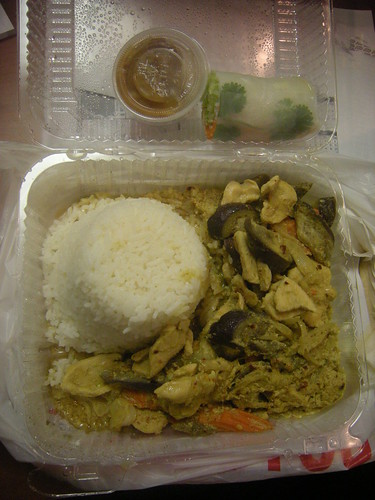
Lunch special yellow curry with chicken, medium spicy.
Overall Curry Rating: 5
Service: 5
The restaurant is in a convereted old house and is beautiful inside. A little more white tablecloth than many Thai places. I called my order in today but last time I ordered and waited. Both times the service was prompt, friendly and accurate.
Presentation/Packaging: 5
The lunch special curry came in a pint sized plastic container with a lid with the rice in a separate to-go container. No leaks or spills or anything. Perfect.
Oh - there was a bit of a red oilslick on top of the curry by the time I got it back to my office to eat. This doesn't bother me, but it might bother some.
Portion Size/Pricing: 4
6.95 for the lunch special. It was a goodly sized meal, but none for leftovers. Well, maybe that COULD have been two meals, but this is curry for pete's sake. I blog about the stuff, I love it. I'm not going to say no :)
Flavor Complexity: 5
This is some of the most interesting and different yellow curry I've had in Portland. It is redder in color than most other restaurants, and part of that may be the spice level. When you say medium, they make it medium not the "you might be able to taste a little spice" medium of most Thai places in Portland. Other than that it has a great saltyness and you can detect fishy flavors every once in a while. Lemongrass pops out occasionally but this cook doesn't lean on the sweet like so many others do. This place is worth going to just for the experience of eating this curry :)
Overall Flavor: 4
As noted, it's a bit spicy. I actually got a little sweaty and lightheaded on the medium spice, so order accordingly. The potatoes and carrots were cooked through, and they gave me plenty of rice.
Anything Else I Ordered: n/a
I didn't get anything else this time, but last time I ordered their special avocado spring rolls. If you've never tasted melty hot avocado in crispy fried won ton skin you are missing out!
Last Thoughts:
Chai Yo has a mighty fine curry. I can't wait to have an excuse to go there sometim and try some of their other dishes. With the care and complexity they bring to their curry I can't help but be excited for their stir fry and noodle dishes!
Thursday, February 12, 2009
Summer, Preserved
Well, it's winter now and decomposing is something I'm doing a lot of. Do you even know how many great movies there are on Netflix? But I do make it up off the couch and into the kitchen occasionally and my favorite meals lately have included the fruits of my summer labor. There is something magical about opening a jar you put up months ago and being transported back to that time and place. I am totally sold on this food preservation thing if for no other reason than the flavor.
But there are, of course, a myriad of other reasons. I have tomatoes in my pantry that I bought for a dollar a pound and canned myself. I spent less money than I would have on organic canned tomatoes AND I know exactly where
I also have a fair amount of wild or "feral" plant life in my pantry. All of my berry preserves and a couple treasured jars of plum sauce came from plants running their own lives in local parks. Sandor Katz talks about wild energy of wild plants and how eating them can infuse that natural, uncultivated wildness into your own life. I've been watching those plum trees for years and ended up with about 15 pounds of plums in one evening of harvesting. I recently discovered the dried
Another great joy of preserving food is having the ability to trade or give it away. I went to visit friends in Southern Oregon last weekend and brought with me a selection of jars from my pantry. One family got applesauce and hot pepper jelly, another plum sauce and blackberry jam. I was able to trade my blackberry jam with another friend for her wild blueberry jam. Both are delicious, and it's all the more exciting to spread a bit of the Southern Oregon mountains on my toast, knowing my dear friend's energy is in it as well. I spent no money on Christmas presents this year either, I just gave away jam.
I recently dug some roasted red peppers out of the freezer to add to my February First Red Soup. My boyfriend brought these peppers home from a U-Pick farm in early September when our dealing-with-food energy reserves were getting low. They looked pleasant enough, even if there were vast quantities of them. And then someone cut into one. Holy moly! We started refering to them as the devil horn peppers. Never kiss a man who has been chopping peppers, not even if he swears he didn't eat any. You will get capsaicin on yo
Here is this years rendition of my traditional red soup that I make every February First. The roasted chiles added a wonderful kick, and I was glad to welcome them back to the table.
*cooking oil (goose grease, coconut oil, or whatever you like)
Have you ever done any food preserving? What is your favorite part of the process? Are you delighting in any out-of-season-from-your-pantry goodies this winter?
Thursday, February 5, 2009
Mission: Yellow Curry PDX Entry 002
Thai Roses Cuisine
6840 SW Beaverton Hillsdale Highway - and yes, that is a Portland address.
http://www.thairosescuisine.com/
What I ordered:
Out to dinner with a friend so we got yellow curry, medium with chicken, pumpkin curry with chicken, spicy eggplant with pork and both steamed and sticky rice.
Overall Curry Rating: 5
Service: 5
Despite having gotten take out there a number of times this was the first time I ever had a sit down meal there. Lovely Thai themed decor and a friendly wait staff. They were out of the special we ordered but the waitress was very helpful and apologetic. Someday I'll have a meal at one of their outdoor tables. They're kind of in the parking lot, but they've put in a lot of plants to make it seem more secluded. No complaints on service.
Presentation/Packaging: 4
They used kind of modern, square bowls and plates to serve the food and everything came with a cute little carrot flower garnish. The sticky rice came in a super cool wicker basket.
Portion Size and Price: 4
8.95 for the dinner sized curry with chicken. I'm OK with that.
Flavor complexity: 4
Sweet and salty and pungent. I love Thai Roses' curry! I didn't like the flavor of the pumpkin curry as much but it did have basil leaves in it reminding me that I like that flavor in yellow
Overall flavor: 4
It was wonderful. The potatoes were cooked through but not mushy, ditto on the carrots. The onion still had some crunch and onion flavor to it, and we even got bell peppers! I could taste a little fish sauce in the curry, but not overwhelmingly so. Could have been a little spicier, but it was very very good.
Anything else I ordered: 3 and 5
The pumpkin curry was a bit of a disappointment. The "pumpkin" was actually squash and it was a little dry and not terribly flavorful. Even with the basil it wasn't quite as tasty of a curry sauce. The spicy eggplant, on the other hand, was unbelievable. I wanted to lick the sauce off the plate after we had scarfed all the eggplant and pork down. I settled for dabbing balls of sticky rice in it. The eggplant were buttery and soft and the sauce garlicky, basily and soy saucey. They used sliced pork which I like, but I've had it elsewhere with ground pork and I think I like that even better. Either way, spicy eggplant rocks! Oh - and it was hardly spicy. Next time I might order that hot instead of medium.
Last thoughts:
It may be the forgotten SW, but it's worth a drive out there. There's a New Seasons around the corner so you can pretend like you are grouping errands together. Everything I've had from these guys has been great and they are always friendly and sweet. I love Thai Roses!
Wednesday, February 4, 2009
Kraut 101
At it's most basic sauerkraut is cabbage and salt, left to ferment into a tangy condiment. The fermentation is completed by a wide variety of bacteria that turn the sugar in the cabbage into acid that in turn preserves the cabbage from spoilage. The live bacteria in unheated sauerkraut
provide immense benefit when eaten including better digestion, increased gut health and an immune system boost. I recently read that the healthy bacteria that live on your skin and in your gut outnumber your body cells 10 to 1 - doesn't it make sense to make sure they are the right kind of bacteria?Here are my instructions for making one quart of jar fermented sauerkraut. This is a great size to start with because it is big enough for everyone to try it a couple times, but not enough that you feel overwhelmed. After your first batch, make a second and try some variations. I'll list some of those down at the bottom.
Phase one: Shopping
1. Find good quality, organic green or purple head cabbage. Look at the grocery store or at farmers markets. Even non-organic ones will ferment just fine, but buy organic if you can. One 8 inch diameter head will be more than enough, but it's not a bad idea to pick up more than you think you'll need. You can use leftovers in a recipe like this soup from Nourishin Days. Weigh your cabbage at the grocery store and remember this number.
2. Buy good quality sea salt. I use Real Salt and highly recommend it because it is "real" salt with micronutrients, but isn't going to break the bank either.
Phase two: Cleaning and Chopping
1. Get a quart size mason jar with a lid. You can either buy 6 or 12 of them new with lids, or find one at a thrift store and buy new lids and rings at the grocery store. You might even have some at home already. Wash it well with soap and hot water.
2. Core and chop your cabbage. Commercial kraut is often made with really finely shredded cabbage. I prefer a little bigger shreds.. more or less as small as I can get them with a knife.
3. As you chop your cabbage stuff it into the jar.. with no salt.. this is just for measuring. Don't pound it in, just stuff it as stuffed as you can get it. When the jar is full pull the cabbage out into the biggest mixing bowl (or a big cooking pot) you have. Add another handful or two of shredded cabbage.
Phase three: Salting and Packing
1. Remember how much your head of cabbage weighed at the grocery store? Do a little mental math estimating how much of the cabbage you used, and multiply that by 2 tsp per pound. For example, your cabbage weighed 2 pounds and you used 3/4 of the head. You used 1 1/2 pounds of cabbage so you need 3 tsp of salt. Figure out how much salt you need and sprinkle that over the cabbage. No need for a calculator here, just guestimate.
2. Toss the cabbag
e and the salt with your hands, squeezing and crunching the cabbage. You should start to see some liquid coming out of the cabbage. Keep kneading and squeezing, thinking about how yummy and healthy this kraut is going to be and how much you love your family for a couple minutes. Alternatively, you could pound the kraut with a wooden pounder or meat tenderizer for a shorter period of time like Jungleen is doing in this photo from Cheeseslave. Either way, the point is to allow the salt to draw the liquid out of the cabbage. Don't give yourself carpal tunnel syndrome, but do allow the cabbage to get wet.3. Taste the cabbage.. it should be distinctly salty. If it is pleasantly salty, add some more salt. If it makes you want to gag add some more shredded cabbage :)
4. Rinse your hands off and start packing the jar. Use a wooden spoon or wooden meat pounder or small ladle to help you really pack the cabbage into the jar. You want to push any air bubbles out. Pack it in a small amount at a time until the cabbage is within 1/2 an inch of the bottom of the threads of the jar.
5. Push on the kraut one last time. If liquid isn't rising above the level of the cabbage then make a brine of about 1 tsp of salt per cup of water (this should also be too salty to be pleasant but not salty enough to make you gag). Slowly pour a little of this over the cabbage, giving it time to sink in, until it is at or above the level of the cabbage.
6. Screw the lid on tight and put in a warmish place in your kitchen. On top of the fridge, the cupboard above the microwave, etc. Do the dishes and leave the cabbage for the day.
Phase Four: Fermenting and Ageing
1. The next day, open the lid of the jar. I recommend doing this over the sink. Did the jar "pop" or fizz when you opened it? If not, that's OK. Taste the kraut. Put the lid back on and put it back in the warm spot.
2. Repeat the last step every day until it truly is popping of fizzing. Taste it again, and then put the lid back on and put that jar in the fridge.
3. Let it sit for at least one more week and then test again. Sour yet? No, let it go anothe week. In the fridge this stuff will last for weeks and months and just get sourer and sourer. Most likely after 2 weeks in the fridge it will be quite sour, but since you've been tasting it the whole time you know what it's like and when you are going to enjoy eating it. I recently found 6 month old kraut in my fridge and it was sour like vinegar pickles. The salty cabbage will eventually get sour, you just need to give it lots and lots and lots of time if thats what you want.
Phase Five: Making the next batch...
Repeat from the beginning, adding some of your sauerkraut juice to the cabbage as your are packing it or instead of the brine.
Once you get the hang of this kraut method you can start making variations. Adding caraway or juniper berries is pretty traditional, as is sliced or grated turnips or carrots. Other vegetable or seasoning options are as limitless as your imagination. Try onions, garlic, seaweed, greens like kale or brussels sprouts, roots like burdock, horseradish or beets. Try mustard seed, dill, curry or hot peppers of some sort. If you add garlic, ginger, chiles and onion you have kim chi but if you use oregano, chiles and cumin you have cortido. I recently made an apple cranberry sauerkraut that is so wonderful. Experiment, it's your kraut!
Please feel free to post comments with your kraut questions, your kraut experiences and your favorite flavor variations. Your question may end up in my future post, Kraut FAQ :)
Friday, January 30, 2009
Mission: Yellow Curry PDX, Entry 001
I've decided to get serious about this goal and start recording my findings. This blog seems like a perfect place to do that first, because it is convenient for me, and also because thai food usually falls within the realm of real food. Thai food is chok full of vegetables, small amounts of meat and seafood, healthy spices and herbs and good fats like coconut milk and peanuts. Fish sauce, a wonderfully nutritious condiment, is almost ubiquitious in Thai cooking. It is also relatively easy to get gluten free meals at thai restaurants becaue of the use of rice and rice noodles (though I would certainly talk to a waiter about possible cross contamination if that is an issue for you). Thai restaurants in America certainly use polyunsaturated vegetable oil for their stir frying and deep frying but if you are good about using healthy fats at home you can probably budget for the occasional Thai meal. If you cook Thai food at home you can make it super healthy with coconut oil, grassfed meat and wild seafood.
Without further ado, I give you Mission: Yellow Curry PDX, Entry 001. Kesone Thai Lao Bistro.
Kesone Thai Lao Bistro
2600 NE Sandy
http://www.kesone.com/menu.htm
What I ordered:
Lunch special yellow curry with eggplant instead of potatoes, medium spicy, with chicken. Also an order of fresh summer rolls.
Overall Curry Rating: 2
Service: 5
The restaurant is very nicely decorated with a pleasant waitstaff. It only took a couple minutes for my order to come. Looks like they have a full bar set up, in case you want Makers Mark with your stir fried eggplant some evening. Presentation/Packaging: 1
I actually would give this a 3 on presentation but a 1 on packaging. They piled the rice neatly, a nice touch, but it was surrounded by curdled, brown yellow colored vegetables. They also packed the lunch special in one of those clear plastic, hinged, to go containers which, as usual, broke and I ended up with half of my curry inside the plastic bag. Hot, liquid things should not go in those plastic containers! They just don't hold up!!
Portion Size and Price: 4
I paid 6.50 for the curry and 3.50 for the rolls. The curry was a perfectly decent size portion so I'm happy.
Flavor complexity: 1
It smells alright, but it just doesn't have much taste at all. Kinda turmericky. Yeah. Just say no.
Overall flavor: 2
I mean, I ate it all. It's still curry. But as noted before, it was curdled a bit, and had no complexity of flavor at all. The eggplant was well cooked (this can be a problem sometimes) but the chicken was almost overcooked. And the rice wasn't even that good - like they used "long grain rice" instead of jasmine or basmati.
Anything else I ordered: 3
The summer rolls were quite nice - hard to mess those up though. I've had more complex peanut sauces before, but it wasn't unpleasant in anyway.
Last thoughts:
I might give these guys another try - if nothing else was open anywhere else in town. I guess I would like to see how they handle stir fry and noodle dishes, but this curry does not bode well for them.
Friday, January 23, 2009
Goose Trois - The Potatoes
To fry potatoes:
1) Cook a goose and render out 1 pint of goose grease.
2) Spend years seasoning a cast iron skillet until it has a perfect patina of use and fat.
3) Spend months developing the perfect, highly nutritious seasoning salt.
4) Peel, chop and cook potatoes in aforementioned grease in aforementioned skillet with aforementioned seasoning salt.
Easy, huh?
I used russet potatoes here and they turned out great. I do like yukon gold potatoes, and you don't even have to peel them. Use whatever you have avaliable.
I seasoned the potatoes, as I season all potatoes with my special, soon to be patented (not really, but maybe - know a patent lawyer?) chile grill salt. It is based on SN from Everything Free Eating's seasoned salt as well as about a million other recipes on Recipezaar. It is chok full of healthful spices and has such an unassuming flavor it can really be used anywhere. Sea salt includes many trace minerals not found in table salt. I use Real Salt, but other sea salts are just as good. Chiles and turmeric are full of antioxidants and cancer fighting nutrients especially needed when grilling or frying food. I use mostly New Mexico chile powder to keep the scovilles down, but a little Arbol or cayenne would kick up the heat nicely. I find Spice Hunter New Mexico chile powder at my local grocery stores. Kelp is a wonderful source of iodine and other sea minerals and doesn't add any noticeable flavors to this mixture. Onion and garlic are also known for their anti-biotic and anti-cancer properties. You just can't go wrong with this stuff!
Alyss' Chile Grill Salt
2 tablespoons sea salt
2 tablespoons paprika
2 tablespoons mild chile powder, or a mix of mild and hot powder
1 tablespoon turmeric
2 teaspoons kelp powder
1 teaspoon onion powder
1 teaspoon garlic powder
1/2 teaspoon nutmeg
1/4 teaspoon ground coriander
1/4 teaspoon ground cumin
Combine everything in an empty glass spice jar. Makes about 3/4 of a cup.
I served my potatoes with homemade sauerkraut, ketchup and cheese. Like I said, it was everything I wanted and more.
Wednesday, January 21, 2009
I'll Fritter Anything
all quick recipes require you to have at least thought about them beforehand. And then there's zucchini fritters - but more on that later.My two main go-to meals when I've got no time are quesadillas and soup. Soup is filling, warming, nutritious and ever so forgiving. Kelly the Kitchen Kop blogged about the nutritional wonders of bone broth as well as gave us directions for making stock, and Carrie over at the Thrifty Oreganic wrote up some great "recipes" for throw together soup. I like to sautee up some onions and spices, throw the meat and broth on top and let that simmer while I change my clothes or take the dog for a walk. Then I'm a little more relaxed when it's time for dinner. With leftover rice, canned beans and decent tortillas in the fridge quesadillas take only minutes. I especially like both soup or quesadillas topped with sour cream and homemade sauerkraut.
Today, though, I want to share with you a brilliant fast food dish - zucchini fritters. I originally got the idea from the Joy of Cooking and have been making it for years. The great thing about this recipe is that really all of it, except the egg and the cast iron skillet, are optional.
Zucchini Fritters
* Necessary:
Grated zucchini
Sliced or grated onion
Egg
Flour (white or whole wheat)
Salt and pepper
* Good to have, but optional:
Cooked brown rice and/or bread crumbs and/or crumbled crackers
Crumbled feta cheese or some other crumbled or grated cheese.
* Even more optional:
Dried green herbs (try herbs de provance or thyme)
Chopped fresh green herbs or green onions.
*Grate zucchini and toss with onion. Add in rice or cracker crumbs and salt, pepper and and any other add ins like cheese or herbs. Crack an egg in the bowl and mix around real good. How much egg you need depends on how big your zucchini is (and how big your egg is) - I would say one 1 cup of zucchini to 1 egg, but that is a very rough guestimate.
*When the veggies are all incorporated in the egg then add a tablespoon of flour. Mix around until thats incorporated and then maybe add another. I would guess I usually add 3 tablespoons of flour to one egg, but again, rough guestimate. If you don't add enough flour the fritter doesn't hold together as well, but it's still totally edible.
*Heat up your cast iron skillet (what? you don't have a cast iron skillet?? Then get off the computer and go buy one. At a thrift store. Seriously.) and melt some fat in it. I like bacon grease, or coconut oil. We're not deep frying here, just lubing up the pan.
*When the skillet is good and hot dollop the batter into the hot fat. When the bottom is nicely browned and the top starting to look dry flip it. Cook till the bottom is browned. Serve with ketchup, ranch, mustard, chutney or ice cream. Not really, but maybe... :)
These guys really take just a few minutes, and just a few ingredients. The eggs and zucchini are real food with real nutrition as is cheese if you use it. Brown rice, especially if cooked with bone broth, and the onions are also nutritious. Using white flour is probably actually nutritionally preferable in this case because we aren't doing anything to neutralize the phytates. It's only a couple tablespoons split up between the fritters so I don't worry too much about it. And we here at Real Food, My Way love frying things in good fats like bacon grease and coconut oil. We know we're getting a good nutrition boost when we cook food that way.
Remember - this "recipe" is really, really loose. Don't have zucchini but do have lots of leftover rice? Make rice fritters. Have leftover cooked greens? Greens fritters. Mashed potatoes? Mashed potato fritters! Don't forget to add the bacon to those ones! Tuna or canned salmon? Call them "cakes" instead of "fritters". No food in the house except frozen corn and an egg? Sounds like corn fritters to me.